SAT: Reading and Writing: Information and Ideas
How central ideas, inferences, and evidence questions actually work
On the exam: Central ideas, inferences, command of evidence including graphs. About 26%.
What's the trap that catches almost everyone on SAT Reading and Writing questions? Picking an answer that sounds true but isn't actually proven by the passage. This video covers central ideas, supporting details, inferences, and command of evidence—including graphs—the way they're tested on this section.
What This Domain Tests
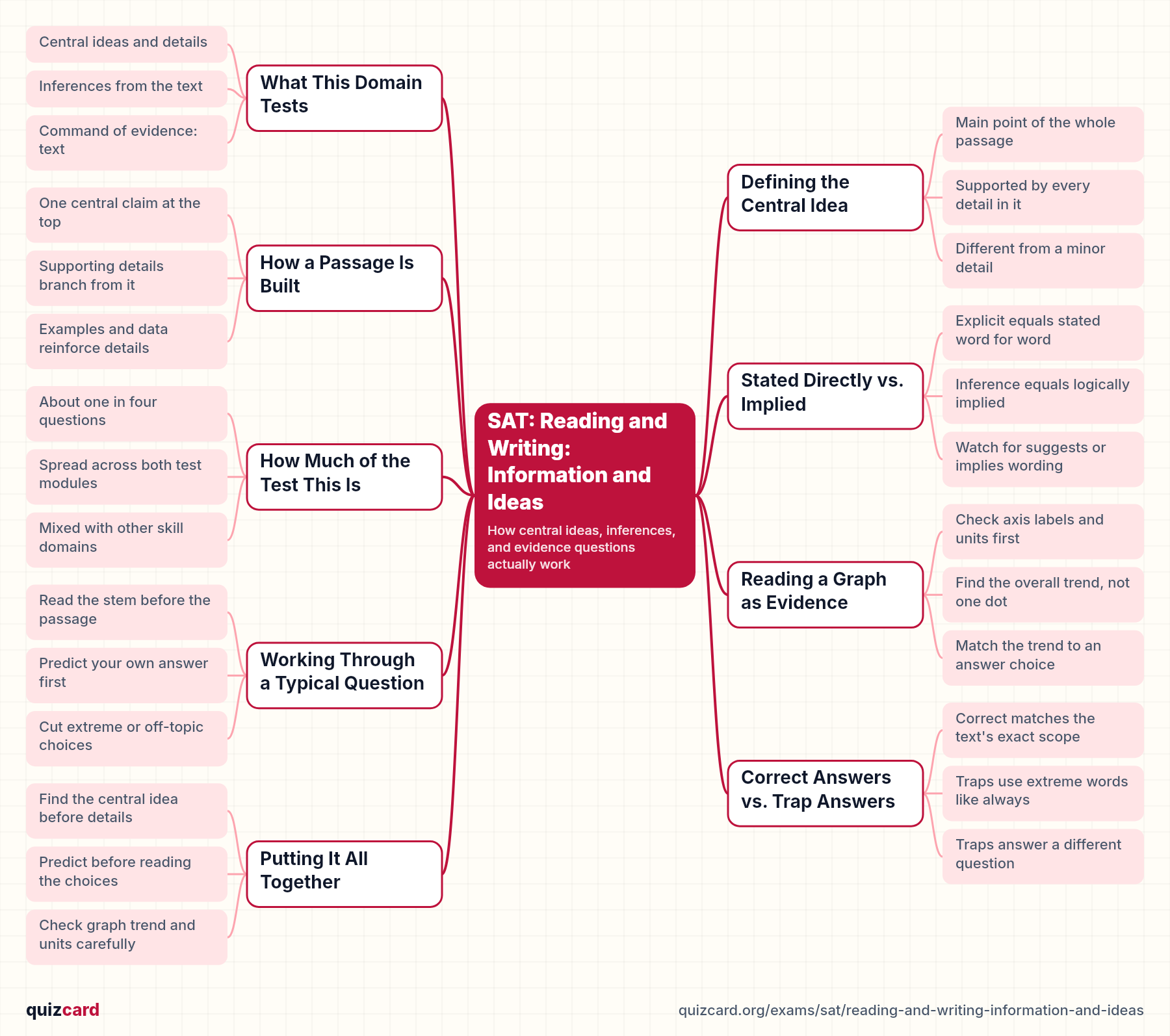
Information and Ideas is the first skill domain on the Reading and Writing section, and it shows up in roughly one out of every four questions. It asks you to find a passage's central idea, pull out supporting details, draw inferences the author implies but never states, and point to the exact evidence—sentence or graph—that proves an answer.
Key points.
- Central ideas and details
- Inferences from the text
- Command of evidence: text
- Command of evidence: graphs
Defining the Central Idea
A central idea question asks what the passage as a whole is really about, not what one sentence says. Picture a short passage about a biologist tracking frog populations: the central idea might be that habitat loss is shrinking frog numbers, while a detail, like one specific wetland losing forty percent of its frogs, only supports that bigger point.
The central idea is the main point a passage makes; every detail, example, and statistic in it exists to support that point. Reading and Writing skill definition
Key points.
- Main point of the whole passage
- Supported by every detail in it
- Different from a minor detail
- Often asked directly or via summary
How a Passage Is Built
Think of a passage as a small tree. At the top sits one central idea, and every branch below it, a detail, an example, a number, exists only to hold that idea up. In a passage about bees, the central idea could be that a parasite is weakening colonies, with branches giving the parasite's name, infection rate, and a beekeeper's observation.
Key points.
- One central claim at the top
- Supporting details branch from it
- Examples and data reinforce details
- Counterpoints sometimes appear too
Stated Directly vs. Implied
Some questions want what the passage literally says, and the right answer restates it closely. Others ask what the text most strongly suggests, which means the answer isn't printed anywhere but has to follow logically from what is written. If a passage says a species was seen only at night, you can infer it avoids daylight, even though no sentence says so directly.
Explicit statements
- Written in the passage word for word
- Answer choice often paraphrases it
- Question says what does the text say
Inferences
- Not written, but logically required
- Question says most strongly suggests
- Must follow from the text, not guess
How Much of the Test This Is
This domain makes up about twenty-six percent of the Reading and Writing section, which works out to roughly a dozen or more questions across the test. That is a big enough share that getting comfortable with central ideas, inferences, and evidence questions moves your score more than almost any other single skill area.
26% share of Reading and Writing questions in this domain
Key points.
- About one in four questions
- Spread across both test modules
- Mixed with other skill domains
- Includes text and graph evidence
Reading a Graph as Evidence
Quantitative command of evidence questions pair a passage with a graph or table and ask which answer choice the data actually supports. Say a line graph shows species count climbing from two hundred to six hundred between 1990 and 2020: the right answer will match that rising trend exactly, not overstate it, and not describe a dip that never happened.
Key points.
- Check axis labels and units first
- Find the overall trend, not one dot
- Match the trend to an answer choice
- Ignore details the graph can't show
Working Through a Typical Question
Take a passage about a marine biologist who finds that reef fish feed less often near loud boat traffic, with a question asking which choice best supports that claim. First read the stem, then the passage, noting the claim about noise and feeding. Predict something like fish feed less near boats, then cut choices about water temperature or coral color, and keep the one citing the feeding-rate data near boats.
- Read the question stem first
- Read the passage for the main claim
- Predict an answer in your own words
- Eliminate extreme or unsupported choices
- Pick the choice the text directly proves
Correct Answers vs. Trap Answers
The test rewards answers that are exactly as strong as the passage, so a trap answer often adds a word like always or never that the text never used. Other traps are true statements that answer a slightly different question than the one being asked, or they flip the passage's cause and effect, making the parasite the result instead of the cause.
Correct answers
- Matches the exact scope of the question
- Supported word for word or by logic
- As strong as the text, no stronger
Trap answers
- Uses always, never, or only
- True statement but off the question
- Reverses cause and effect
Putting It All Together
Across every question type in this domain, the winning habit is the same: understand what the passage or graph actually says before you look at the answer choices, then hold every choice to that exact standard. If you can state the central idea in your own words and point to the line or data that proves it, you are reading the way these questions expect you to.
Key points.
- Find the central idea before details
- Predict before reading the choices
- Check graph trend and units carefully
- Match answer strength to the text
Remember this
The one thing to remember: on the SAT, a correct answer is always proven by the text or the graph, never just plausible. Quiz yourself on a few passages and graphs to check your answers.
Practice this unit
- SAT Vocabulary: 40 High-Frequency Words quiz24 multiple-choice questions with explanations · no account needed
- Algebra and Geometry: Essential Formulas quiz18 multiple-choice questions with explanations · no account needed
- GRE Quantitative: Arithmetic, Algebra, Geometry and Data Formulas quiz15 multiple-choice questions with explanations · no account needed
- SAT Vocabulary: 40 High-Frequency Words40 flashcards · study free
- Algebra and Geometry: Essential Formulas30 flashcards · study free
- Geometry: Proofs, Triangles, and Circles30 flashcards · study free
- English Literature: Literary Terms and Devices30 flashcards · study free
Every SAT deck and quiz: the SAT hub.
Other SAT unit guides
- Math: Advanced MathStudy guide
- Math: AlgebraStudy guide
- Math: Geometry and TrigonometryStudy guide
- Math: Problem-Solving and Data AnalysisStudy guide
- Reading and Writing: Craft and StructureStudy guide
- Reading and Writing: Expression of IdeasStudy guide
- Reading and Writing: Standard English ConventionsStudy guide
Try it with your own material
Upload a PDF, slides or notes and study the deck in minutes. Making your own cards is free with no limits.