SAT: Math: Geometry and Trigonometry
Area, volume, angle rules, circle formulas, and right-triangle trig ratios explained
On the exam: Area, volume, angles, circles, right-triangle trigonometry. About 15%.
Think you can read a geometry diagram and skip the formula sheet? On the SAT, geometry and trigonometry make up about fifteen percent of the math questions, and this video covers area, volume, angles, circles, and right-triangle trigonometry the way the test actually asks about them.
Area and Volume Formulas
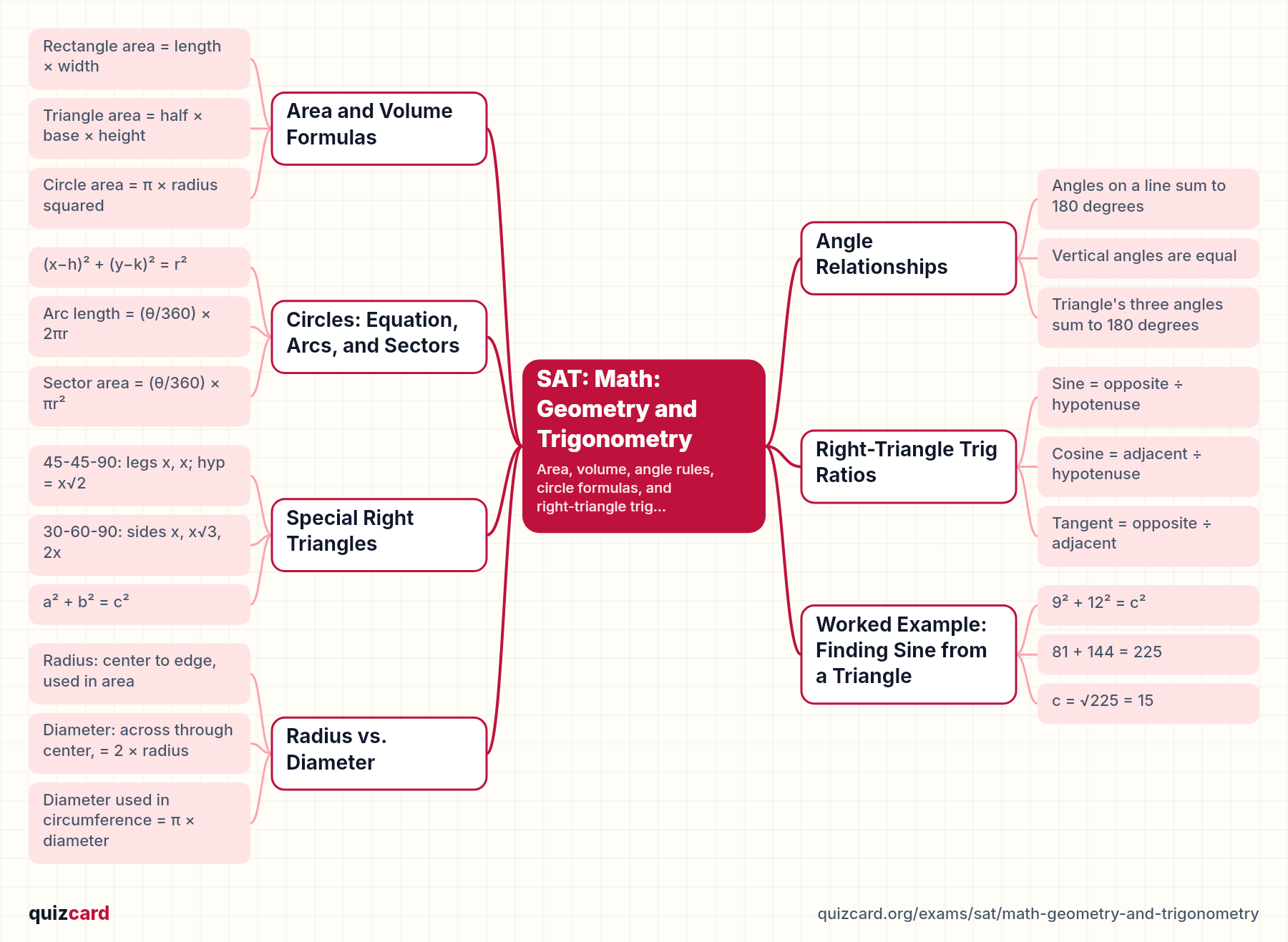
The SAT gives you a formula sheet on every math section, but you still need to know which formula fits which shape. Area measures a flat region, like length times width for a rectangle or half of base times height for a triangle. Volume measures three-dimensional space, like length times width times height for a rectangular box, or four-thirds pi r cubed for a sphere.
Key points.
- Rectangle area = length × width
- Triangle area = half × base × height
- Circle area = π × radius squared
- Volume = length × width × height (box)
Angle Relationships
When two parallel lines are cut by a third line, called a transversal, the angles formed follow set rules: corresponding angles are equal, and angles on a straight line add up to one hundred eighty degrees. Inside any triangle, the three interior angles always sum to one hundred eighty degrees as well, a fact that shows up constantly once you start working with multi-shape figures.
Key points.
- Angles on a line sum to 180 degrees
- Vertical angles are equal
- Triangle's three angles sum to 180 degrees
- Parallel lines cut by a transversal create equal angles
Circles: Equation, Arcs, and Sectors
A circle centered at the point h, k with radius r satisfies the equation x minus h squared plus y minus k squared equals r squared. For a slice of that circle, arc length is the fraction of the way around, theta over three sixty, times the full circumference, two pi r. Sector area works the same way, theta over three sixty times pi r squared.
(x−h)² + (y−k)² = r²
Arc length = (θ/360) × 2πr
Sector area = (θ/360) × πr²
Key points.
- Center (h,k), radius r defines a circle
- Arc length is a fraction of circumference
- Sector area is a fraction of total area
- θ is the central angle in degrees
Right-Triangle Trig Ratios
In a right triangle, every acute angle has three basic ratios built from its sides. Sine is opposite over hypotenuse, cosine is adjacent over hypotenuse, and tangent is opposite over adjacent, often remembered as SOH-CAH-TOA. These ratios depend only on the angle, so a thirty-degree angle always gives the same sine, no matter the triangle's size.
Sine equals opposite over hypotenuse, cosine equals adjacent over hypotenuse, tangent equals opposite over adjacent. SOH-CAH-TOA
Key points.
- Sine = opposite ÷ hypotenuse
- Cosine = adjacent ÷ hypotenuse
- Tangent = opposite ÷ adjacent
- Ratios depend only on the angle, not triangle size
Special Right Triangles
Two triangle shapes come up again and again. In a forty-five, forty-five, ninety triangle, the legs are equal length x, and the hypotenuse is x times the square root of two. In a thirty, sixty, ninety triangle, the sides are x, x root three, and two x. Both follow from the Pythagorean theorem, a squared plus b squared equals c squared.
45-45-90: legs x, x; hyp = x√2
30-60-90: sides x, x√3, 2x
a² + b² = c²
Key points.
- 45-45-90 triangle: legs x, x, hypotenuse x√2
- 30-60-90 triangle: sides x, x√3, 2x
- Pythagorean theorem: a² + b² = c²
- Works only in right triangles
Worked Example: Finding Sine from a Triangle
Here's a typical question. A right triangle has legs of nine and twelve. First, apply the Pythagorean theorem: nine squared plus twelve squared equals c squared. That's eighty-one plus one forty-four, which is two twenty-five, so c, the hypotenuse, is fifteen. Now find the sine of the angle opposite the twelve-length leg: that's opposite over hypotenuse, twelve over fifteen, which simplifies to four over five.
9² + 12² = c²
81 + 144 = 225
c = √225 = 15
sin(θ) = 12 ÷ 15
sin(θ) = 4/5
Key points.
- Legs 9 and 12, find hypotenuse
- Apply a² + b² = c²
- c = 15 after taking square root
- sin(θ) = opposite ÷ hypotenuse = 4/5
Radius vs. Diameter
A common slip is mixing up radius and diameter. The radius runs from the center to the edge and plugs directly into area and sector formulas. The diameter runs all the way across through the center and equals twice the radius; it's the value used in circumference, pi times diameter. Confusing the two is one of the easiest ways to miss an otherwise simple circle question.
Radius
- Center to edge
- Used in area = πr²
- Used in arc and sector formulas
Diameter
- All the way across, through center
- Equals 2 × radius
- Used in circumference = πd
Remember this
The one thing to carry forward: match the right formula or ratio to the shape in front of you, whether that's area, a circle's arc, or a trig ratio in a right triangle. That's the core of the SAT's geometry and trigonometry questions. Now try quizzing yourself on these formulas and a few practice problems to make sure they stick.
Practice this unit
- SAT Vocabulary: 40 High-Frequency Words quiz24 multiple-choice questions with explanations · no account needed
- Algebra and Geometry: Essential Formulas quiz18 multiple-choice questions with explanations · no account needed
- GRE Quantitative: Arithmetic, Algebra, Geometry and Data Formulas quiz15 multiple-choice questions with explanations · no account needed
- SAT Vocabulary: 40 High-Frequency Words40 flashcards · study free
- Algebra and Geometry: Essential Formulas30 flashcards · study free
- Geometry: Proofs, Triangles, and Circles30 flashcards · study free
- English Literature: Literary Terms and Devices30 flashcards · study free
Every SAT deck and quiz: the SAT hub.
Other SAT unit guides
- Math: Advanced MathStudy guide
- Math: AlgebraStudy guide
- Math: Problem-Solving and Data AnalysisStudy guide
- Reading and Writing: Craft and StructureStudy guide
- Reading and Writing: Expression of IdeasStudy guide
- Reading and Writing: Information and IdeasStudy guide
- Reading and Writing: Standard English ConventionsStudy guide
Try it with your own material
Upload a PDF, slides or notes and study the deck in minutes. Making your own cards is free with no limits.