SAT: Reading and Writing: Expression of Ideas
Learn how to match notes to a goal and words to logic, with a worked question
On the exam: Rhetorical synthesis and transitions. About 20%.
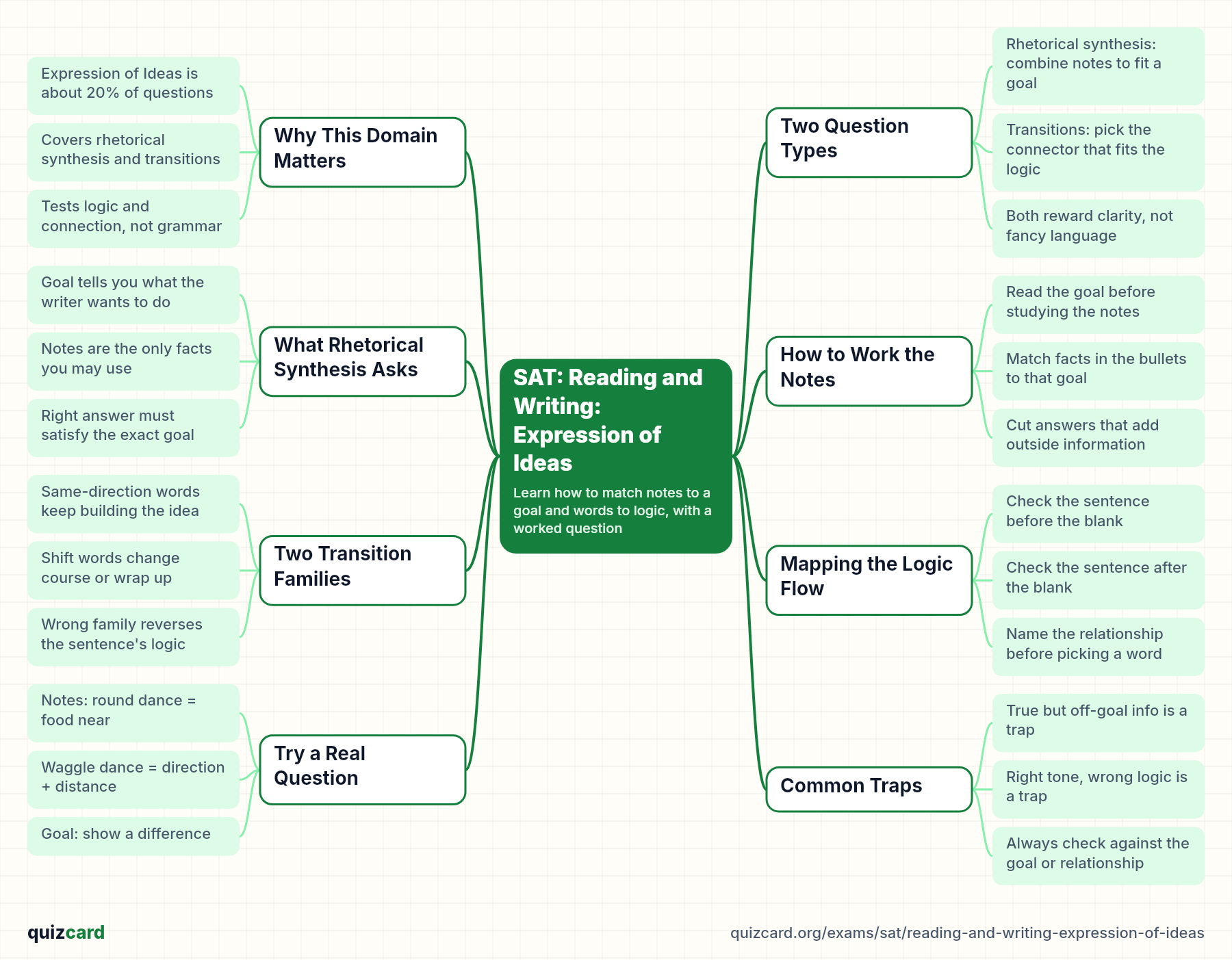
Ever picked the transition that sounded smartest and still gotten the question wrong? On the SAT, Expression of Ideas questions aren't about fancy vocabulary. This video covers rhetorical synthesis and transitions, the logic behind each, and walks through a real practice question step by step.
Why This Domain Matters
Here's a number worth knowing before you start practicing. About twenty percent of the questions in this section come from the Expression of Ideas domain. That one slice covers two skills: rhetorical synthesis, where you combine research notes into one sentence, and transitions, where you pick the word that links two ideas. Neither one tests grammar or spelling at all.
20% Share of questions testing rhetorical synthesis and transitions
Key points.
- Expression of Ideas is about 20% of questions
- Covers rhetorical synthesis and transitions
- Tests logic and connection, not grammar
Two Question Types
This domain has two question types that ask the same underlying question: does this choice communicate the idea clearly? In a rhetorical synthesis question, you get bullet point notes plus a stated goal, and you pick the sentence that best uses those notes to meet it. In a transitions question, you get two sentences and a blank, and you choose the word that correctly links them.
Key points.
- Rhetorical synthesis: combine notes to fit a goal
- Transitions: pick the connector that fits the logic
- Both reward clarity, not fancy language
- Neither tests spelling or comma rules
What Rhetorical Synthesis Asks
This question type always follows the same setup: imagine you've done research and written down notes, then you're given a specific goal, like comparing two things or introducing a topic. Your job isn't to add outside knowledge or pick the most interesting fact. It's to use only what's in the notes and build the one option that actually accomplishes that stated goal, nothing more and nothing less.
Using only the given notes, choose the option that best accomplishes the stated goal. the rhetorical synthesis question stem
Key points.
- Goal tells you what the writer wants to do
- Notes are the only facts you may use
- Right answer must satisfy the exact goal
How to Work the Notes
Here's a reliable order of operations. First, read the goal sentence before you study the notes closely, because it tells you what you're building toward. Second, scan the bullets for facts that actually serve that goal. Third, cross out any answer that brings in information not found in the notes. Fourth, cross out answers that are accurate but don't address the goal. What remains is correct.
- Read the stated goal first
- Scan notes for matching facts
- Eliminate answers with outside info
- Eliminate accurate but off-goal answers
- Keep the option that fits exactly
Two Transition Families
Transition words fall into two broad families. Same direction words like furthermore, for example, and indeed tell you the next sentence keeps building on the last one. Shift or conclude words like however, therefore, and in conclusion signal a contrast, a result, or a wrap up. Picking a word from the wrong family is the most common mistake, because the sentence can sound smooth even when the logic is backwards.
Add or Illustrate
- Furthermore, moreover - add a point
- For example, specifically - illustrate
- Indeed, in fact - emphasize
Shift or Conclude
- However, nevertheless - contrast
- Therefore, consequently - show result
- In conclusion, thus - wrap up
Mapping the Logic Flow
To answer a transitions question, don't memorize a list of words. Instead, read the sentence before the blank and the sentence after it, and ask how they relate. Does the second sentence add another example, like adding a new detail? Does it push back against the first, signaling contrast? Or does it state a result or a conclusion? Once you name that relationship, only one family of words fits.
Key points.
- Check the sentence before the blank
- Check the sentence after the blank
- Name the relationship before picking a word
Try a Real Question
Let's work a real rhetorical synthesis question. The notes say the round dance signals that food is near, and the waggle dance adds direction and distance for food that's farther away. The goal is to emphasize a difference between the two dances. So we need one sentence naming both dances and contrasting them. The correct choice opens with 'unlike the round dance,' then states what the waggle dance adds.
Notes: round dance = food near
Waggle dance = direction + distance
Goal: show a difference
Need: name both, contrast them
Correct: 'Unlike round dance...'
Wrong: describes only one dance
Key points.
- Notes describe two honeybee dances
- Goal asks for a contrast between them
- Correct answer names both and contrasts them
Common Traps
Two traps show up again and again. In rhetorical synthesis, a wrong answer often states something true from the notes, but it doesn't do what the goal asked, so it's off target even though it's accurate. In transitions, a wrong answer often sounds smooth but reverses the logic, using 'however' when the sentences actually agree. Always check the choice against the goal or the relationship, not against how it reads.
Synthesis Trap
- True fact from the notes
- Doesn't match the stated goal
- Looks right, scores wrong
Transition Trap
- Smooth sounding word
- Reverses the real relationship
- Ignores what the sentences say
Remember this
The one thing to remember: rhetorical synthesis is about matching notes to a goal, and transitions are about matching logic, not sound. Try quizzing yourself with a few practice SAT questions from this unit to see which trap catches you.
Practice this unit
- SAT Vocabulary: 40 High-Frequency Words quiz24 multiple-choice questions with explanations · no account needed
- Algebra and Geometry: Essential Formulas quiz18 multiple-choice questions with explanations · no account needed
- GRE Quantitative: Arithmetic, Algebra, Geometry and Data Formulas quiz15 multiple-choice questions with explanations · no account needed
- SAT Vocabulary: 40 High-Frequency Words40 flashcards · study free
- Algebra and Geometry: Essential Formulas30 flashcards · study free
- Geometry: Proofs, Triangles, and Circles30 flashcards · study free
- English Literature: Literary Terms and Devices30 flashcards · study free
Every SAT deck and quiz: the SAT hub.
Other SAT unit guides
- Math: Advanced MathStudy guide
- Math: AlgebraStudy guide
- Math: Geometry and TrigonometryStudy guide
- Math: Problem-Solving and Data AnalysisStudy guide
- Reading and Writing: Craft and StructureStudy guide
- Reading and Writing: Information and IdeasStudy guide
- Reading and Writing: Standard English ConventionsStudy guide
Try it with your own material
Upload a PDF, slides or notes and study the deck in minutes. Making your own cards is free with no limits.