SAT: Reading and Writing: Craft and Structure
Learn to read words in context, how passages are built, and why authors write what they do
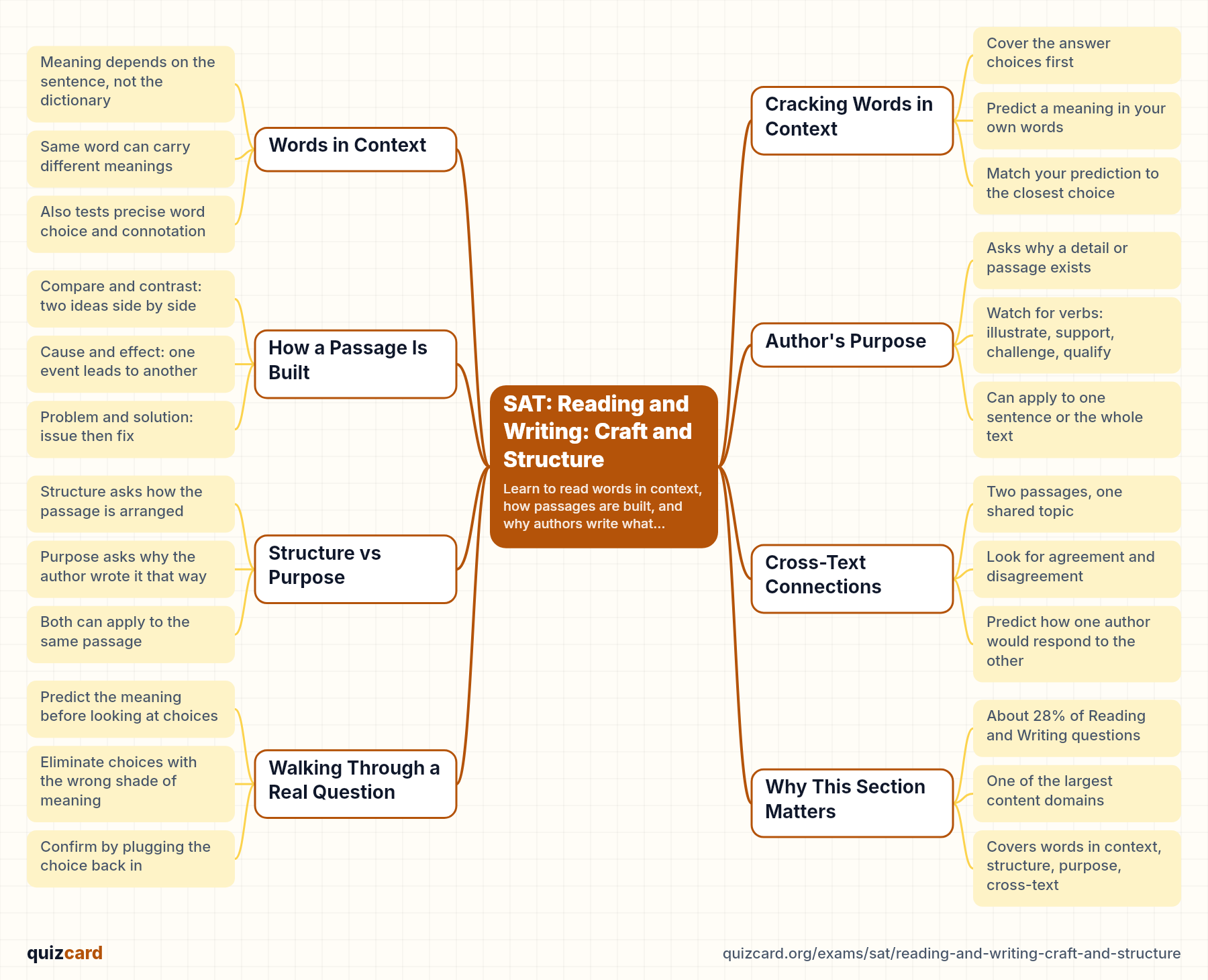
On the exam: Words in context, text structure and purpose, cross-text connections. About 28% of the section.
Ever picked the dictionary definition of a word on a reading question and still gotten it wrong? That's the trap Craft and Structure sets on the SAT. This video covers words in context, how passages are built, why authors write what they do, and how to connect two passages at once.
Words in Context
Picture the word cold appearing in two sentences: one about freezing weather, another about someone's unfriendly reply. Words in Context questions test exactly this, figuring out what a word or phrase means based on the specific sentence around it, not its dictionary definition. You're not recalling vocabulary; you're reading context clues and deciding which shade of meaning actually fits the passage in front of you.
Determine the meaning of a word or phrase as it is used in a specific passage. SAT Reading and Writing framework
Key points.
- Meaning depends on the sentence, not the dictionary
- Same word can carry different meanings
- Also tests precise word choice and connotation
Cracking Words in Context
Here's a reliable method. First, cover the answer choices so they don't bias you. Second, reread the sentence and predict a meaning in your own words, maybe the author means careful rather than weak. Third, scan the choices for the one closest to your prediction. Finally, plug that word back into the sentence and check that it still makes sense before locking it in.
- Cover the answer choices
- Reread the sentence and predict a meaning
- Scan choices for the closest match
- Plug the choice back in to confirm
How a Passage Is Built
Passages are built using recognizable patterns. A compare and contrast structure sets two ideas side by side, like two competing scientific theories. A cause and effect structure traces how one event leads to another, say explaining why a species declined. A problem and solution structure raises an issue then proposes a fix, and a chronological structure simply moves through time, step by step.
Key points.
- Compare and contrast: two ideas side by side
- Cause and effect: one event leads to another
- Problem and solution: issue then fix
- Chronological: events in time order
Author's Purpose
Purpose questions ask why the author included a specific detail, sentence, or even the whole passage, not what it says. Common answers use verbs like illustrate, support, challenge, acknowledge, or qualify. For example, a sentence might exist to illustrate a claim made earlier, or a paragraph might exist to acknowledge a counterargument before refuting it. The right answer always matches the author's intention, not just the topic.
Key points.
- Asks why a detail or passage exists
- Watch for verbs: illustrate, support, challenge, qualify
- Can apply to one sentence or the whole text
- Focus on intention, not just topic
Structure vs Purpose
Structure and purpose sound alike but ask different things. A structure question asks how the passage is arranged, say moving from problem to solution. A purpose question asks why the author chose to write it that way, perhaps to persuade readers the solution is worth adopting. A passage can be organized chronologically yet still exist mainly to argue a point, so always separate the how from the why.
Structure Questions
- How is the passage organized
- How does one part relate to another
- The blueprint of the text
Purpose Questions
- Why did the author include this
- What is the author trying to achieve
- The intention behind the text
Cross-Text Connections
Some questions give you two short passages on a related topic and ask how they connect. You might be asked where the authors would agree, where they'd disagree, or how the second author would respond to a claim in the first. For instance, if passage one argues a policy works and passage two presents data undermining it, the question tests whether you can weigh both viewpoints together, not just summarize each one separately.
Key points.
- Two passages, one shared topic
- Look for agreement and disagreement
- Predict how one author would respond to the other
- Requires weighing both viewpoints together
Walking Through a Real Question
Let's try one. The passage reads: her delicate adjustments kept her balanced on the wire. The question asks what delicate most nearly means, with choices fragile, breakable, careful, and dainty. Predict first: the walker isn't fragile, she's being careful. That eliminates fragile and breakable, which describe physical weakness. Dainty feels close but implies daintiness, not skill. Careful fits best, and rereading the sentence with careful confirms it makes sense.
- Sentence: her delicate adjustments kept her balanced
- Predict a meaning: careful, precise
- Eliminate fragile and breakable, wrong shade
- Choose careful since it fits the action
- Reread with careful to confirm it fits
Why This Section Matters
Craft and Structure makes up about twenty-eight percent of the Reading and Writing section, making it one of the largest content domains on the test. That means roughly one in four questions you see will test words in context, structure, purpose, or cross-text connections. Getting comfortable with these question types pays off across nearly every passage you encounter, not just a handful of questions.
28% share of SAT Reading and Writing questions testing Craft and Structure
Key points.
- About 28% of Reading and Writing questions
- One of the largest content domains
- Covers words in context, structure, purpose, cross-text
- Skills apply across almost every passage
Remember this
The one thing to remember: context decides meaning and intention decides purpose, never assume the obvious answer. Craft and Structure is a large chunk of the SAT, so quiz yourself on these question types until the process feels automatic.
Practice this unit
- SAT Vocabulary: 40 High-Frequency Words quiz24 multiple-choice questions with explanations · no account needed
- Algebra and Geometry: Essential Formulas quiz18 multiple-choice questions with explanations · no account needed
- GRE Quantitative: Arithmetic, Algebra, Geometry and Data Formulas quiz15 multiple-choice questions with explanations · no account needed
- SAT Vocabulary: 40 High-Frequency Words40 flashcards · study free
- Algebra and Geometry: Essential Formulas30 flashcards · study free
- Geometry: Proofs, Triangles, and Circles30 flashcards · study free
- English Literature: Literary Terms and Devices30 flashcards · study free
Every SAT deck and quiz: the SAT hub.
Other SAT unit guides
- Math: Advanced MathStudy guide
- Math: AlgebraStudy guide
- Math: Geometry and TrigonometryStudy guide
- Math: Problem-Solving and Data AnalysisStudy guide
- Reading and Writing: Expression of IdeasStudy guide
- Reading and Writing: Information and IdeasStudy guide
- Reading and Writing: Standard English ConventionsStudy guide
Try it with your own material
Upload a PDF, slides or notes and study the deck in minutes. Making your own cards is free with no limits.