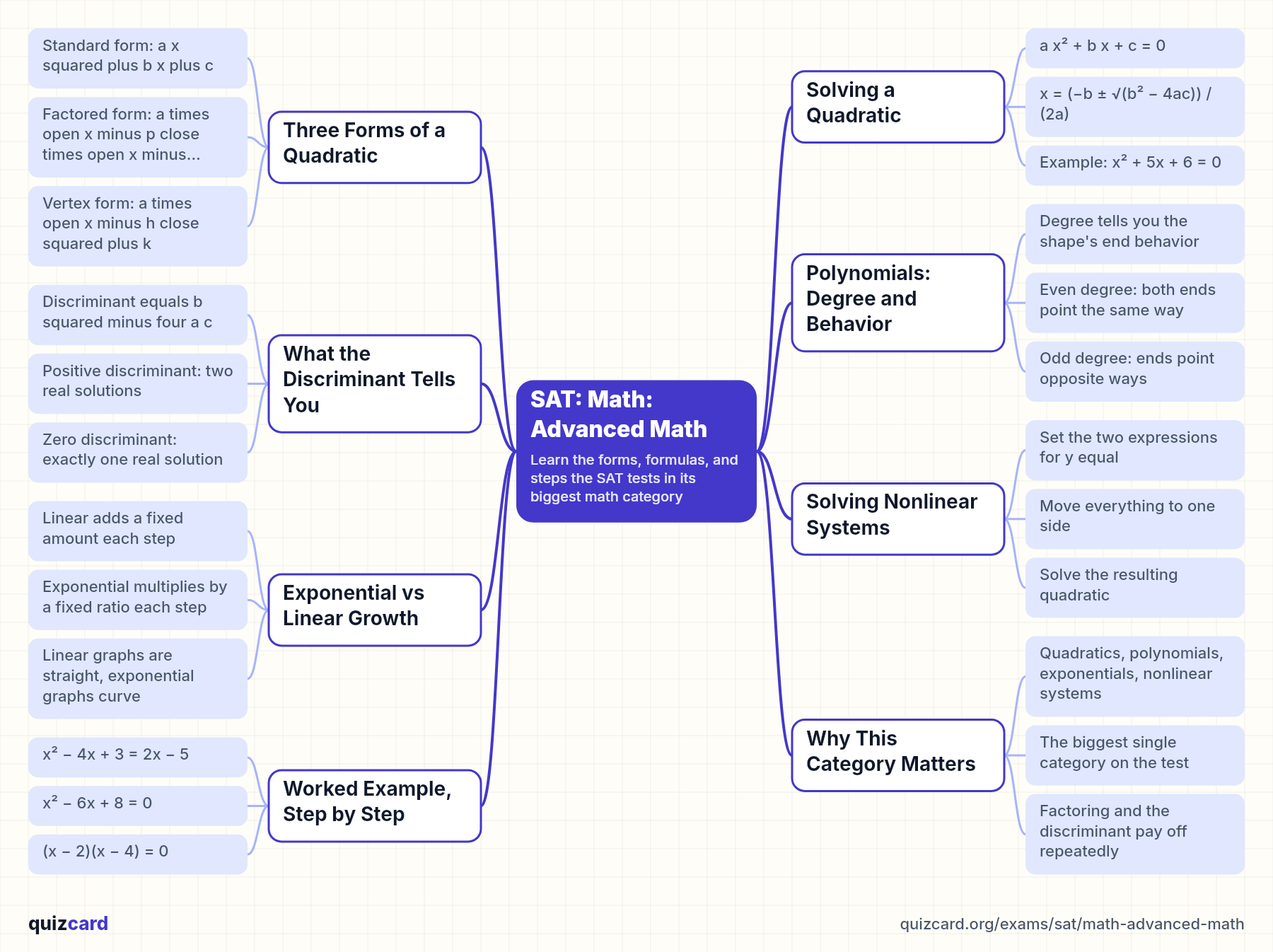
SAT: Math: Advanced Math
Learn the forms, formulas, and steps the SAT tests in its biggest math category
On the exam: Quadratics, polynomials, exponentials, nonlinear systems. About 35%.
Think every quadratic needs the quadratic formula? Not even close. On the SAT, the single largest math category is called Advanced Math, and this video walks through quadratics, polynomials, exponential functions, and nonlinear systems, the way the test actually asks about them.
Three Forms of a Quadratic
Every quadratic can be written three ways, and the SAT expects you to switch between them. Standard form shows you the constant term. Factored form, like x minus two times x minus three, hands you the roots directly, two and three. Vertex form shows the highest or lowest point of the parabola without any extra work. Picking the right form saves you time on the test.
Key points.
- Standard form: a x squared plus b x plus c
- Factored form: a times open x minus p close times open x minus q close
- Vertex form: a times open x minus h close squared plus k
- Each form reveals something different about the graph
Solving a Quadratic
To solve any quadratic, start by setting it equal to zero. If it factors nicely, you're done quickly. If not, use the quadratic formula: x equals negative b, plus or minus the square root of b squared minus four a c, all over two a. Take x squared plus five x plus six equals zero. Here a is one, b is five, c is six, and plugging in gives x equals negative two or negative three.
a x² + b x + c = 0
x = (−b ± √(b² − 4ac)) / (2a)
Example: x² + 5x + 6 = 0
a = 1, b = 5, c = 6
x = (−5 ± √(25 − 24)) / 2
x = −2 or x = −3
Key points.
- Set the quadratic equal to zero
- Try factoring first
- Use the quadratic formula when it won't factor
- Check your answers by substitution
What the Discriminant Tells You
Before you even solve a quadratic, the discriminant tells you how many real solutions to expect. It's the part under the square root in the quadratic formula, b squared minus four a c. If it's positive, the parabola crosses the x axis twice. If it's exactly zero, the parabola just touches the axis once, at its vertex. If it's negative, the parabola never touches the axis at all, so there are no real solutions.
Key points.
- Discriminant equals b squared minus four a c
- Positive discriminant: two real solutions
- Zero discriminant: exactly one real solution
- Negative discriminant: no real solutions
Polynomials: Degree and Behavior
A polynomial's degree, the highest exponent, controls how its graph behaves at the far left and far right. An even degree, like x to the fourth, sends both ends in the same direction, usually both up. An odd degree, like x cubed, sends one end up and one end down. At each zero, check the multiplicity: a zero that repeats an even number of times just touches the x axis, while an odd multiplicity crosses straight through it.
Key points.
- Degree tells you the shape's end behavior
- Even degree: both ends point the same way
- Odd degree: ends point opposite ways
- Even multiplicity touches the axis, odd multiplicity crosses it
Exponential vs Linear Growth
Linear and exponential functions get mixed up constantly on the SAT, so here's the clean split. A linear function, like y equals three x plus two, adds the same amount every time x increases by one. An exponential function, like y equals two times three to the x, multiplies by the same ratio every time. That's why exponential graphs start slow and then shoot upward or decay toward zero, while linear graphs stay a straight line the whole way.
Linear
- Adds a fixed amount each step
- Graph is a straight line
- Example: y = 3x + 2
Exponential
- Multiplies by a fixed ratio each step
- Graph curves, grows or decays fast
- Example: y = 2 × 3^x
Solving Nonlinear Systems
A nonlinear system usually pairs a line with a parabola, and solving it is really just a quadratic problem in disguise. Since both equations equal y, you can set them equal to each other. That gives you a quadratic to solve, which might have zero, one, or two solutions, matching zero, one, or two points where the line actually meets the curve. Once you have the x values, plug each one back into either equation to get the matching y value.
- Set the two expressions for y equal
- Move everything to one side so it equals zero
- Solve the resulting quadratic equation
- Substitute each x value back in to find y
- Write each result as a point, x comma y
Worked Example, Step by Step
Here's a typical question: find where y equals x squared minus four x plus three meets y equals two x minus five. Set them equal: x squared minus four x plus three equals two x minus five. Move everything to one side: x squared minus six x plus eight equals zero. That factors into x minus two times x minus four, so x equals two or four. Plugging back into the line gives y equals negative one, and y equals three.
x² − 4x + 3 = 2x − 5
x² − 6x + 8 = 0
(x − 2)(x − 4) = 0
x = 2 or x = 4
y = 2(2) − 5 = −1
y = 2(4) − 5 = 3
Key points.
- Set the parabola equal to the line
- Simplify into standard quadratic form
- Factor to find the x values
- Substitute back to find the y values
Why This Category Matters
Advanced Math isn't just one more topic among many, it's the biggest chunk of the whole math section. That means every minute you spend getting comfortable with factoring, the discriminant, end behavior, and setting up nonlinear systems pays off across a large share of the questions you'll actually see. The patterns repeat: recognize the form, choose the right tool, and the problem usually collapses into something you've already practiced.
35% share of SAT math questions classified as Advanced Math
Key points.
- Quadratics, polynomials, exponentials, nonlinear systems
- The biggest single category on the test
- Factoring and the discriminant pay off repeatedly
- Knowing which form to use saves real time
Remember this
The one thing to remember: almost every Advanced Math question is really asking you to find where a curve meets a line or an axis, so get comfortable setting expressions equal. Now quiz yourself on factoring, the discriminant, and these SAT Advanced Math questions.
Practice this unit
- SAT Vocabulary: 40 High-Frequency Words quiz24 multiple-choice questions with explanations · no account needed
- Algebra and Geometry: Essential Formulas quiz18 multiple-choice questions with explanations · no account needed
- GRE Quantitative: Arithmetic, Algebra, Geometry and Data Formulas quiz15 multiple-choice questions with explanations · no account needed
- SAT Vocabulary: 40 High-Frequency Words40 flashcards · study free
- Algebra and Geometry: Essential Formulas30 flashcards · study free
- Geometry: Proofs, Triangles, and Circles30 flashcards · study free
- English Literature: Literary Terms and Devices30 flashcards · study free
Every SAT deck and quiz: the SAT hub.
Other SAT unit guides
- Math: AlgebraStudy guide
- Math: Geometry and TrigonometryStudy guide
- Math: Problem-Solving and Data AnalysisStudy guide
- Reading and Writing: Craft and StructureStudy guide
- Reading and Writing: Expression of IdeasStudy guide
- Reading and Writing: Information and IdeasStudy guide
- Reading and Writing: Standard English ConventionsStudy guide
Try it with your own material
Upload a PDF, slides or notes and study the deck in minutes. Making your own cards is free with no limits.