MCAT: Psychology and sociology
The key terms of perception, learning, memory, personality and society, and how they're tested
On the exam: Perception, learning, memory, personality, social structures and demographics. Heavily term-based.
Quick question: is negative reinforcement the same as punishment? If you said yes, you're in good company, and you're wrong. In this video, we'll go through perception, learning, memory, personality, social structures and demographics, one term at a time, and then work through a typical exam question together.
Sensation, Perception and Processing
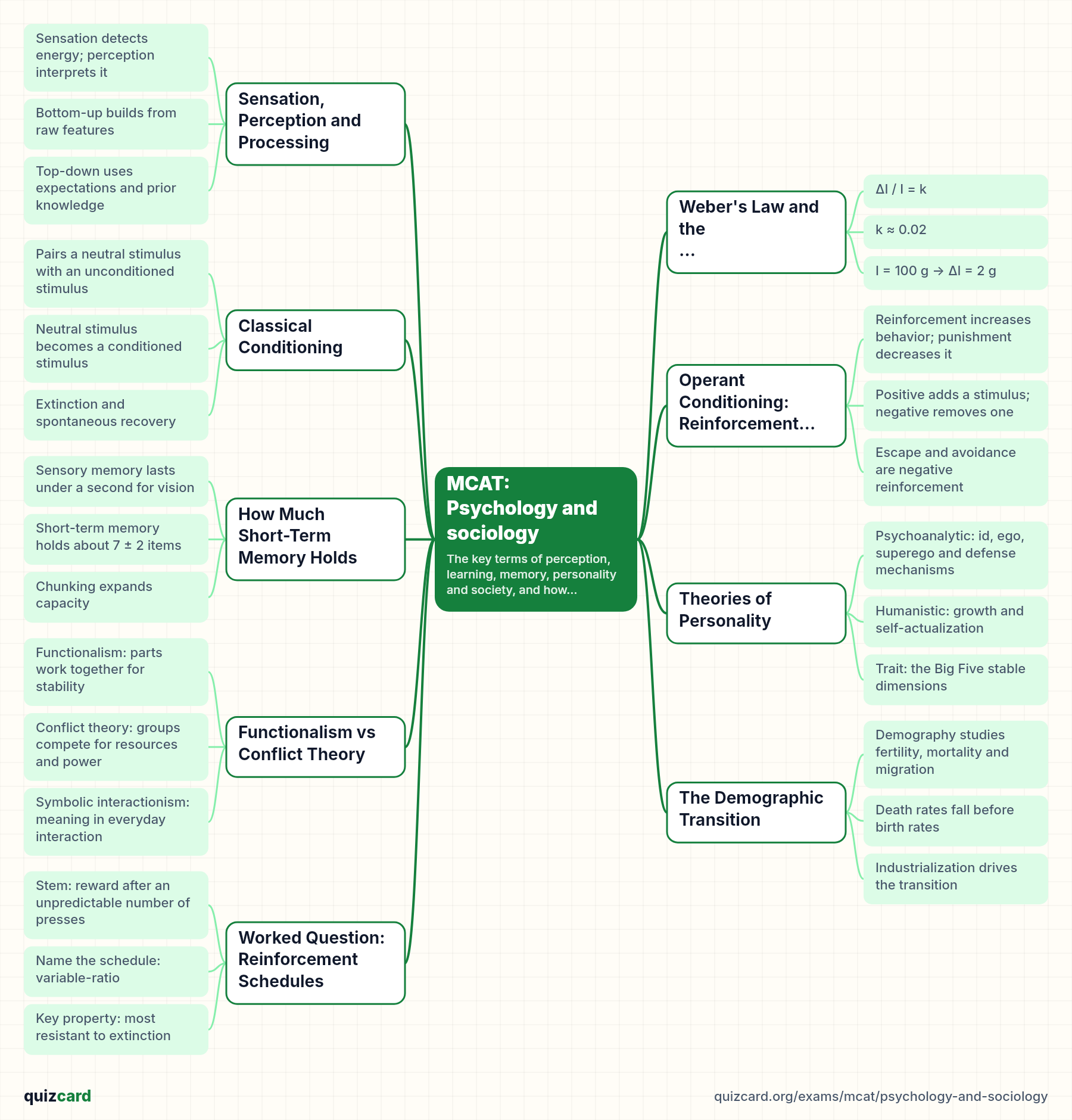
Perception starts with sensation, but the two aren't the same thing. Sensation is your receptors detecting energy, like light hitting the retina, while perception is your brain organizing and interpreting it. Bottom-up processing builds a picture from raw features. Top-down processing uses expectations and prior knowledge, which is why you can read a word with a missing letter. Gestalt principles describe how you group what you see.
Bottom-up processing
- Starts with raw sensory features
- Data-driven, piece by piece
- Used for unfamiliar stimuli
Top-down processing
- Starts with expectations and knowledge
- Concept-driven interpretation
- Lets you read a word with missing letters
Weber's Law and the Just-Noticeable Difference
The just-noticeable difference follows Weber's law. You write it as the change in intensity divided by the starting intensity equals a constant, k. Say k for lifted weight is about two percent. Holding one hundred grams, you'd need about two grams more to notice. Holding two hundred grams, you'd need four. The difference you can detect scales with what you start with, not a fixed amount.
ΔI / I = k
k ≈ 0.02
I = 100 g → ΔI = 2 g
I = 200 g → ΔI = 4 g
Key points.
- JND is the smallest detectable change
- Weber's law: change over intensity is constant
- The JND grows with the starting intensity
Classical Conditioning
Classical conditioning pairs two stimuli. In Pavlov's dogs, food is the unconditioned stimulus, and salivating to it is the unconditioned response. Ring a neutral bell just before the food repeatedly, and the bell becomes a conditioned stimulus that triggers salivation on its own, now called the conditioned response. Ring the bell without food and the response fades, which is extinction. If it returns after a rest, that's spontaneous recovery.
- Food (US) triggers salivation (UR)
- Pair a neutral bell with the food repeatedly
- Bell alone becomes the conditioned stimulus (CS)
- Bell triggers salivation, the conditioned response
- Bell without food leads to extinction
Operant Conditioning: Reinforcement vs Punishment
Operant conditioning is about consequences. Reinforcement always increases a behavior, and punishment always decreases it. Positive means you add something, and negative means you take something away. So taking an aspirin to get rid of a headache is negative reinforcement, because removing the pain makes you more likely to take aspirin again. Escape and avoidance learning are both forms of negative reinforcement too.
Key points.
- Reinforcement increases behavior; punishment decreases it
- Positive adds a stimulus; negative removes one
- Escape and avoidance are negative reinforcement
How Much Short-Term Memory Holds
Memory moves through stages. Sensory memory holds a brief snapshot, under a second for visual iconic memory. Short-term memory holds about seven items, plus or minus two, for roughly twenty to thirty seconds unless you rehearse them. Chunking stretches that limit, like grouping a phone number into three parts. Elaborative rehearsal, linking new facts to meaning, is what moves information into long-term memory.
7 ± 2 Items short-term memory holds at once, per George Miller
Key points.
- Sensory memory lasts under a second for vision
- Short-term memory holds about 7 ± 2 items
- Chunking expands capacity
- Elaborative rehearsal moves info to long-term memory
Theories of Personality
Personality theories differ in where they look for causes. Freud's psychoanalytic view puts the id, ego and superego in conflict, with defense mechanisms like repression protecting the ego. Humanistic theorists like Rogers and Maslow focus on growth and self-actualization. Trait theory measures stable dimensions, summarized as the Big Five. Bandura's social cognitive theory adds reciprocal determinism, where behavior, thoughts and environment all shape one another.
Key points.
- Psychoanalytic: id, ego, superego and defense mechanisms
- Humanistic: growth and self-actualization
- Trait: the Big Five stable dimensions
- Social cognitive: reciprocal determinism, self-efficacy
Functionalism vs Conflict Theory
Sociology looks at social structure through a few big lenses. Functionalism sees society as interdependent parts that keep things stable, each with manifest, intended functions and latent, unintended ones. Conflict theory, rooted in Marx, sees groups competing for scarce resources, with inequality and power driving change. Both are macro views. Symbolic interactionism zooms in to the micro level, asking how people create meaning through symbols in everyday interaction.
Functionalism
- Society as interdependent parts
- Manifest and latent functions
- Focus on stability and equilibrium
Conflict theory
- Groups compete for scarce resources
- Inequality and power, from Marx
- Change comes through struggle
The Demographic Transition
Demography studies populations through three variables: fertility, mortality and migration. The demographic transition describes how they shift as a society industrializes. At first, both birth and death rates are high, so population stays stable. Then better food and medicine cut death rates, and the population booms. Later, birth rates fall too, and the society ends with low birth and death rates and a stable, older population.
- Stage 1: high birth and death rates, stable
- Stage 2: death rates fall, population booms
- Stage 3: birth rates begin to fall
- Stage 4: low birth and death rates, stable
Worked Question: Reinforcement Schedules
Let's try a typical question. A researcher rewards a rat with a pellet after an unpredictable number of lever presses, then stops the pellets entirely. Which outcome is most likely? First, name the schedule: rewards depend on presses, so it's ratio, and they're unpredictable, so it's variable. Variable-ratio schedules produce high, steady responding and the most resistance to extinction, so the rat keeps pressing longest.
Key points.
- Stem: reward after an unpredictable number of presses
- Name the schedule: variable-ratio
- Key property: most resistant to extinction
- Answer: the rat keeps pressing the longest
Remember this
If you remember one thing, make it this: reinforcement increases behavior, punishment decreases it, and positive or negative only means adding or removing. Now quiz yourself on these terms until each definition comes instantly.
Practice this unit
- Biology: Cell Structure and Function quiz18 multiple-choice questions with explanations · no account needed
- AP Biology: Genetics and Heredity quiz18 multiple-choice questions with explanations · no account needed
- Chemistry: Atomic Structure and Periodic Trends quiz13 multiple-choice questions with explanations · no account needed
- Biology: Cell Structure and Function30 flashcards · study free
- AP Biology: Genetics and Heredity30 flashcards · study free
- Organic Chemistry: Functional Groups and Reactions30 flashcards · study free
- Chemistry: Stoichiometry and Chemical Reactions30 flashcards · study free
Every MCAT deck and quiz: the MCAT hub.
Other MCAT unit guides
- Biology and biochemistryStudy guide
- CARSStudy guide
- General chemistryStudy guide
- Organic chemistryStudy guide
- PhysicsStudy guide
Try it with your own material
Upload a PDF, slides or notes and study the deck in minutes. Making your own cards is free with no limits.