MCAT: Organic chemistry
Learn how structure predicts reactivity, separation, and the spectra you read to prove it
On the exam: Functional groups, reactions, stereochemistry, separations and spectroscopy.
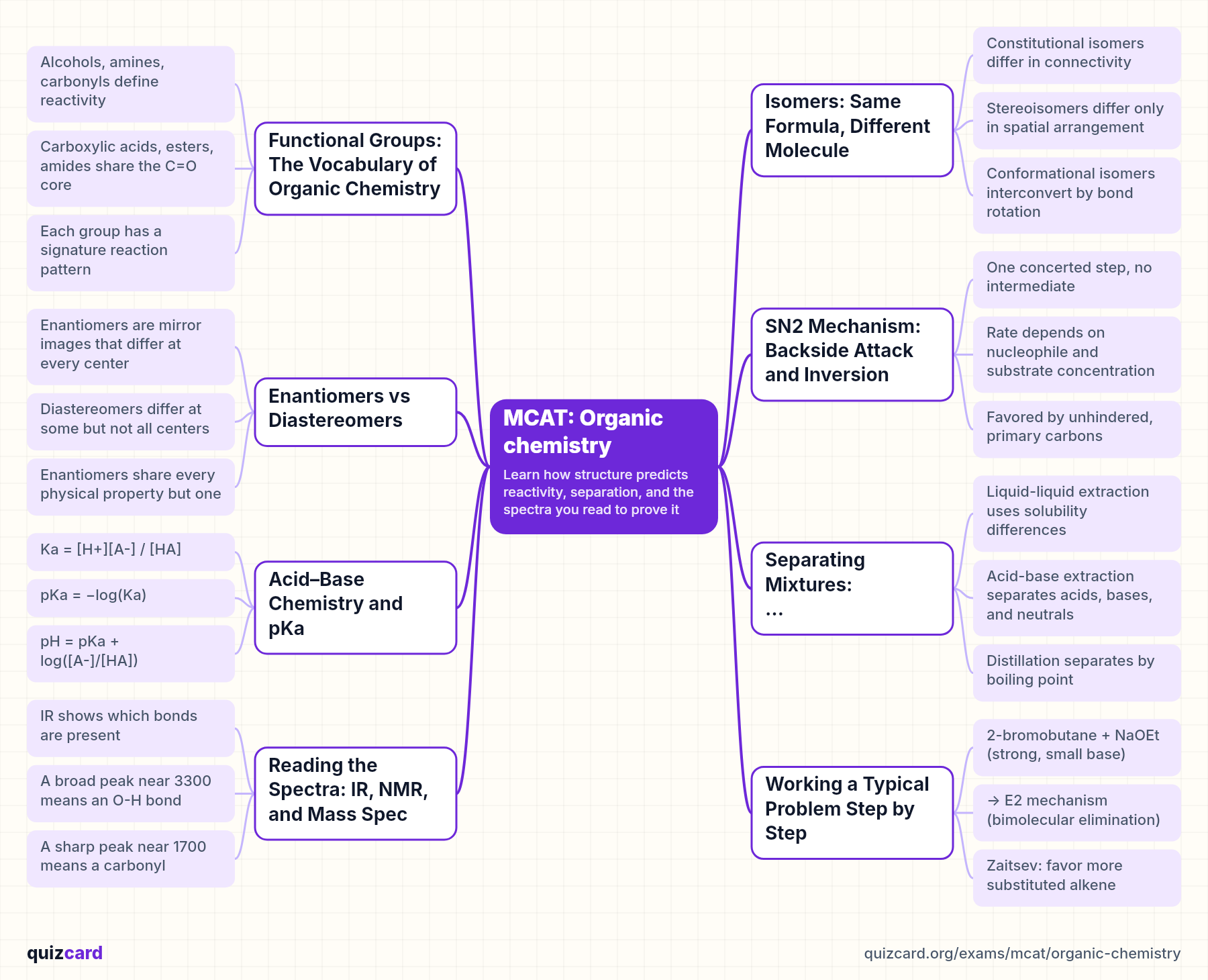
Think a molecule's R or S label tells you which way it bends light? It doesn't, and that mix-up costs points on the MCAT. We'll cover functional groups, stereochemistry, reaction mechanisms, separations, and spectroscopy, then work through a typical problem step by step.
Functional Groups: The Vocabulary of Organic Chemistry
Before you can predict any reaction, you need to recognize what's sitting on the molecule. An alcohol has an oxygen with a hydrogen attached, a carbonyl has a carbon double bonded to oxygen, and a carboxylic acid combines both in one group. Esters, amides, and amines each react differently because of that one group. Spotting the functional group first is usually the fastest way to guess the reaction mechanism.
Key points.
- Alcohols, amines, carbonyls define reactivity
- Carboxylic acids, esters, amides share the C=O core
- Each group has a signature reaction pattern
- Recognizing them predicts how a molecule behaves
Isomers: Same Formula, Different Molecule
Two molecules can share the exact same formula and still be completely different substances. If the atoms are connected in a different order, that's a constitutional isomer, like butane versus isobutane. If the connectivity is identical but the spatial arrangement differs, that's a stereoisomer. Spinning around a single bond gives a conformational isomer, but changing a double bond's geometry or a stereocenter's arrangement gives a configurational isomer that won't interconvert without breaking a bond.
Stereoisomers share the same molecular formula and the same atom-to-atom connectivity, but differ in how their atoms are arranged in space. Organic chemistry nomenclature
Key points.
- Constitutional isomers differ in connectivity
- Stereoisomers differ only in spatial arrangement
- Conformational isomers interconvert by bond rotation
- Configurational isomers require breaking a bond to interconvert
Enantiomers vs Diastereomers
Picture a molecule with two stereocenters. If you flip every single one, you get its mirror image, an enantiomer, and the two behave identically except for how they bend polarized light and how they interact with other chiral molecules. But if you flip only one stereocenter and leave the other alone, you get a diastereomer, a genuinely different compound with its own melting point, boiling point, and solubility.
Enantiomers
- Non-superimposable mirror images
- Differ at every stereocenter
- Identical physical properties
- Rotate plane-polarized light oppositely
Diastereomers
- Not mirror images of each other
- Differ at some, not all, stereocenters
- Different melting and boiling points
- Include cis/trans and meso relationships
SN2 Mechanism: Backside Attack and Inversion
In an SN2 reaction, the nucleophile doesn't wait for anything to leave first. It attacks the carbon directly opposite the leaving group, pushing through a transition state where the carbon is briefly bonded to both groups at once. As the leaving group exits the other side, the carbon's configuration flips completely, the way an umbrella turns inside out in a strong wind. That's why SN2 always produces inversion, never retention.
- Nucleophile approaches opposite the leaving group
- A pentacoordinate transition state forms
- The leaving group departs as the bond breaks
- The carbon's configuration flips, like an umbrella in wind
Acid–Base Chemistry and pKa
Start with the acid dissociation constant, Ka, equal to the concentration of hydrogen ion times the conjugate base, over the undissociated acid. Taking the negative log gives pKa, a number that tells you acid strength directly, lower means stronger. The Henderson-Hasselbalch equation connects pH to pKa and the ratio of base to acid. So if a carboxylic acid's pKa is four point seven six and the ratio of deprotonated to protonated form is ten to one, the pH works out to five point seven six.
Ka = [H+][A-] / [HA]
pKa = −log(Ka)
pH = pKa + log([A-]/[HA])
Given pKa = 4.76, ratio A-:HA = 10:1
pH = 4.76 + log(10) = 5.76
Key points.
- Lower pKa means a stronger acid
- Henderson-Hasselbalch links pH, pKa, and ratio
- Carboxylic acids are far more acidic than alcohols
- Use it to find which form dominates at a given pH
Separating Mixtures: Extraction, Distillation, Chromatography
Once you've made a molecule, you usually need to pull it out of a mixture. Liquid-liquid extraction shakes the mixture between water and an organic solvent, and adjusting the pH can convert an acid or a base into its charged, water-loving form so it moves into the aqueous layer. Distillation separates compounds by boiling point instead. Thin-layer chromatography separates by polarity, and the Rf value, distance the spot traveled divided by distance the solvent traveled, tells you how polar a compound is.
Key points.
- Liquid-liquid extraction uses solubility differences
- Acid-base extraction separates acids, bases, and neutrals
- Distillation separates by boiling point
- Chromatography separates by polarity, measured as Rf
Reading the Spectra: IR, NMR, and Mass Spec
Each spectroscopic method answers a different question. Infrared spectroscopy tells you which bonds are present, a broad peak around three thousand three hundred wavenumbers signals an O-H bond, while a sharp spike near seventeen hundred signals a carbonyl. Proton NMR tells you about the hydrogen environment, chemical shift tells you what's nearby, integration tells you how many hydrogens, and splitting follows the n plus one rule, counting neighboring hydrogens. Mass spectrometry gives you the molecular weight from the molecular ion peak.
Key points.
- IR shows which bonds are present
- A broad peak near 3300 means an O-H bond
- A sharp peak near 1700 means a carbonyl
- NMR splitting follows the n plus one rule
Working a Typical Problem Step by Step
Say the question gives you 2-bromobutane reacting with sodium ethoxide and asks for the major product. First, recognize ethoxide is a strong base that isn't bulky, which points to elimination rather than substitution, specifically E2. Next, apply Zaitsev's rule, the major product is the more substituted alkene, so you remove a hydrogen that gives 2-butene instead of 1-butene. Finally, between the two geometries, the trans form is more stable, so trans-2-butene is your answer.
2-bromobutane + NaOEt (strong, small base)
→ E2 mechanism (bimolecular elimination)
Zaitsev: favor more substituted alkene
Major product: 2-butene (trans favored)
Key points.
- Identify the base: strong and not bulky favors E2
- E2 needs anti-periplanar H and leaving group
- Zaitsev's rule favors the more substituted alkene
- Trans alkene is more stable than cis
Remember this
The one thing to hold onto is that structure dictates everything: shape and functional groups determine mechanism, polarity determines separation, and bonds determine spectra. Quiz yourself on identifying functional groups, naming mechanisms, and reading a spectrum before your MCAT prep moves on.
Practice this unit
- Biology: Cell Structure and Function quiz18 multiple-choice questions with explanations · no account needed
- AP Biology: Genetics and Heredity quiz18 multiple-choice questions with explanations · no account needed
- Chemistry: Atomic Structure and Periodic Trends quiz13 multiple-choice questions with explanations · no account needed
- Biology: Cell Structure and Function30 flashcards · study free
- AP Biology: Genetics and Heredity30 flashcards · study free
- Organic Chemistry: Functional Groups and Reactions30 flashcards · study free
- Chemistry: Stoichiometry and Chemical Reactions30 flashcards · study free
Every MCAT deck and quiz: the MCAT hub.
Other MCAT unit guides
- Biology and biochemistryStudy guide
- CARSStudy guide
- General chemistryStudy guide
- PhysicsStudy guide
- Psychology and sociologyStudy guide
Try it with your own material
Upload a PDF, slides or notes and study the deck in minutes. Making your own cards is free with no limits.