MCAT: CARS
How CARS passages are built, what the three question types test, and how to work a question
On the exam: Critical analysis and reasoning on humanities and social-science passages. No outside knowledge needed; practice, not cards.
Ever picked the answer that sounded true in real life, only to get it wrong? That's the trap CARS sets on the MCAT. This video walks through what the section tests, how passages are built, the three question types, and how to work through an actual question step by step.
The CARS Section at a Glance
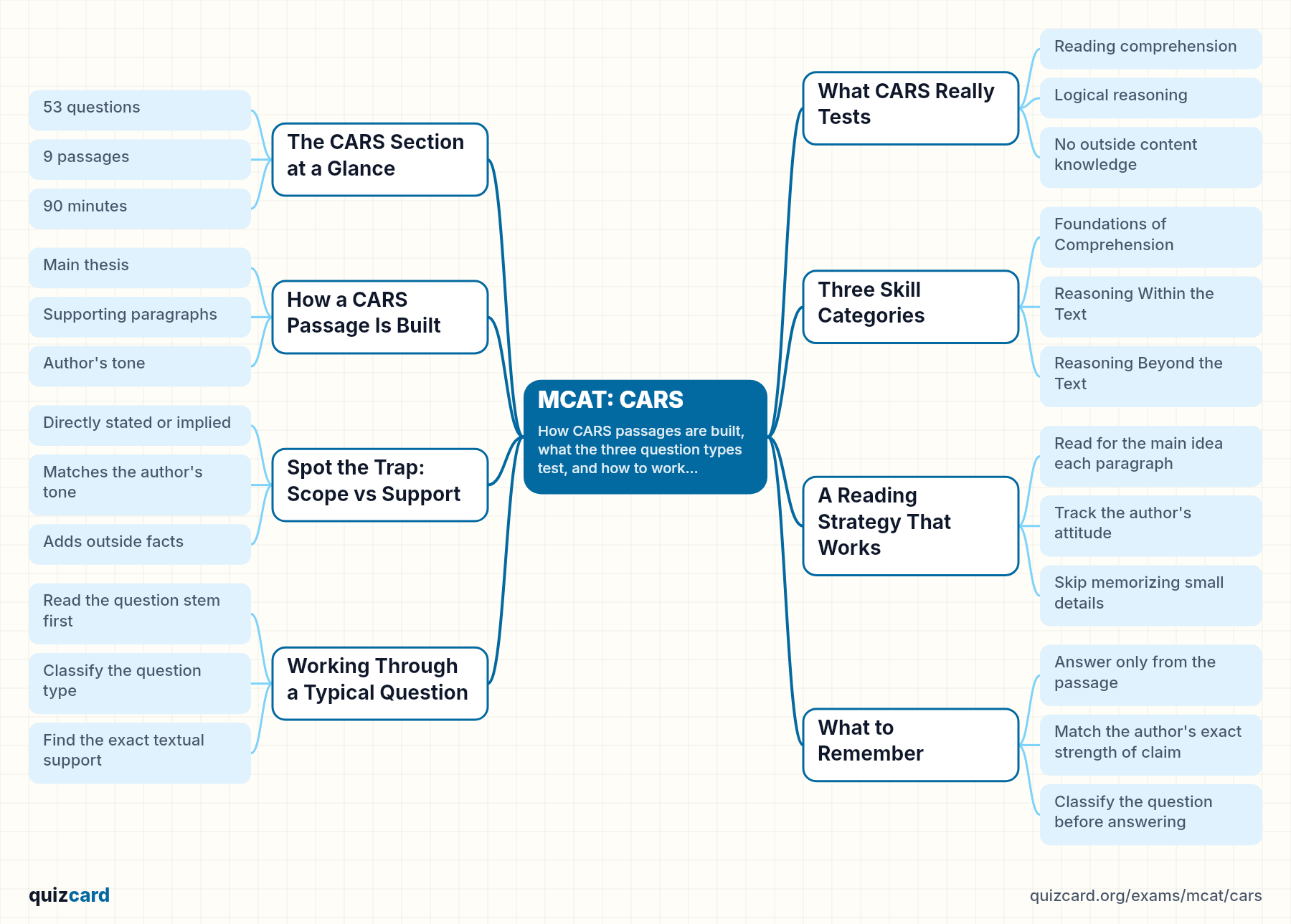
Before you even open a passage, it helps to know the shape of the test. CARS gives you fifty three questions spread across nine passages, and you get ninety minutes total, so roughly ten minutes a passage. There's no biology, no chemistry, no physics tested here. Every answer has to come from the words on the page, which means the section rewards careful reading over memorized facts.
53 Questions across nine humanities and social science passages in ninety minutes
Key points.
- 53 questions
- 9 passages
- 90 minutes
- No science content
What CARS Really Tests
The official description calls it Critical Analysis and Reasoning Skills, and that name is the whole point. You're not being asked what you know about philosophy or history. You're being asked to read a passage on something like art criticism or economics and reason about what the author actually argues, how the pieces of the argument fit together, and what follows logically from them.
Passages test how well you can read, understand, and reason about an argument, not what you already know about the topic. MCAT Official Guide, AAMC
Key points.
- Reading comprehension
- Logical reasoning
- No outside content knowledge
- Humanities and social science topics
How a CARS Passage Is Built
Picture a typical passage as a small essay. There's usually one main thesis the author is defending, several paragraphs that supply evidence or examples for that thesis, and often a paragraph that raises an opposing view before the author responds to it. Underneath all of this sits the author's tone, whether they're skeptical, admiring, or neutral, and that tone is tested just as often as the content.
Key points.
- Main thesis
- Supporting paragraphs
- Author's tone
- Counterarguments
Three Skill Categories
The MCAT sorts CARS questions into three skill categories. Foundations of Comprehension asks what the passage literally says, or what a word means in context. Reasoning Within the Text asks you to connect parts of the passage, like spotting an assumption or explaining an example. Reasoning Beyond the Text asks you to apply the argument to a new situation, or judge how new information would strengthen or weaken it.
- Foundations: what does the text say
- Reasoning Within: how do the parts connect
- Reasoning Beyond: apply the argument elsewhere
Spot the Trap: Scope vs Support
Wrong answers on CARS usually fail in one of two predictable ways. Some answers step outside the passage's scope, bringing in a true fact about history or science that the author never mentioned. Others go too far, using words like always, never, or completely when the passage only hints at something mild. A right answer stays inside what the passage actually supports, in the strength the author actually used.
Textually Supported
- Stated or clearly implied
- Matches the author's strength of claim
Common Traps
- Brings in outside knowledge
- Overstates with always or never
- Contradicts the author's tone
A Reading Strategy That Works
Because every question sends you back to specific lines, you don't need to memorize the passage on the first read. What you do need is a sense of where the main idea sits in each paragraph and how the author feels about the subject. Many strong scorers read once for structure and tone, then go line by line only when a question points them back to a particular detail.
Key points.
- Read for the main idea each paragraph
- Track the author's attitude
- Skip memorizing small details
- Reread only when a question demands it
Working Through a Typical Question
Say a passage argues that early newspapers both informed and manipulated public opinion, and the question asks the author's attitude toward the industry. You classify it as a Reasoning Within the Text question about tone, then scan for the author's own words, like shaped or exploited. Calling the author purely admiring is too extreme; calling the industry corrupt by modern standards adds outside judgment. Powerful but morally mixed stays closest.
- Classify: tone question, reasoning within text
- Scan for author's own descriptive words
- Eliminate the purely admiring answer
- Eliminate the outside-judgment answer
- Pick the answer matching mixed tone
What to Remember
If you take one thing from this, let it be that every correct answer on CARS can be pointed to in the passage itself, nothing more and nothing less. There's no formula sheet to memorize here. The only way to get faster and more accurate is to practice full passages under time, noticing your own patterns of mistakes, since this is a skill built through repetition.
Key points.
- Answer only from the passage
- Match the author's exact strength of claim
- Classify the question before answering
- Practice passages, not flashcards
Remember this
The one thing to carry forward: on the MCAT, CARS rewards what the passage says, not outside knowledge or gut feeling. Try quizzing yourself with a timed passage and see if you can justify every answer with a specific line.
Practice this unit
- Biology: Cell Structure and Function quiz18 multiple-choice questions with explanations · no account needed
- AP Biology: Genetics and Heredity quiz18 multiple-choice questions with explanations · no account needed
- Chemistry: Atomic Structure and Periodic Trends quiz13 multiple-choice questions with explanations · no account needed
- Biology: Cell Structure and Function30 flashcards · study free
- AP Biology: Genetics and Heredity30 flashcards · study free
- Organic Chemistry: Functional Groups and Reactions30 flashcards · study free
- Chemistry: Stoichiometry and Chemical Reactions30 flashcards · study free
Every MCAT deck and quiz: the MCAT hub.
Other MCAT unit guides
- Biology and biochemistryStudy guide
- General chemistryStudy guide
- Organic chemistryStudy guide
- PhysicsStudy guide
- Psychology and sociologyStudy guide
Try it with your own material
Upload a PDF, slides or notes and study the deck in minutes. Making your own cards is free with no limits.