MCAT: Physics
The core equations and concepts you need to recall cold
On the exam: Mechanics, fluids, circuits, waves and optics, with equations you must recall without a sheet.
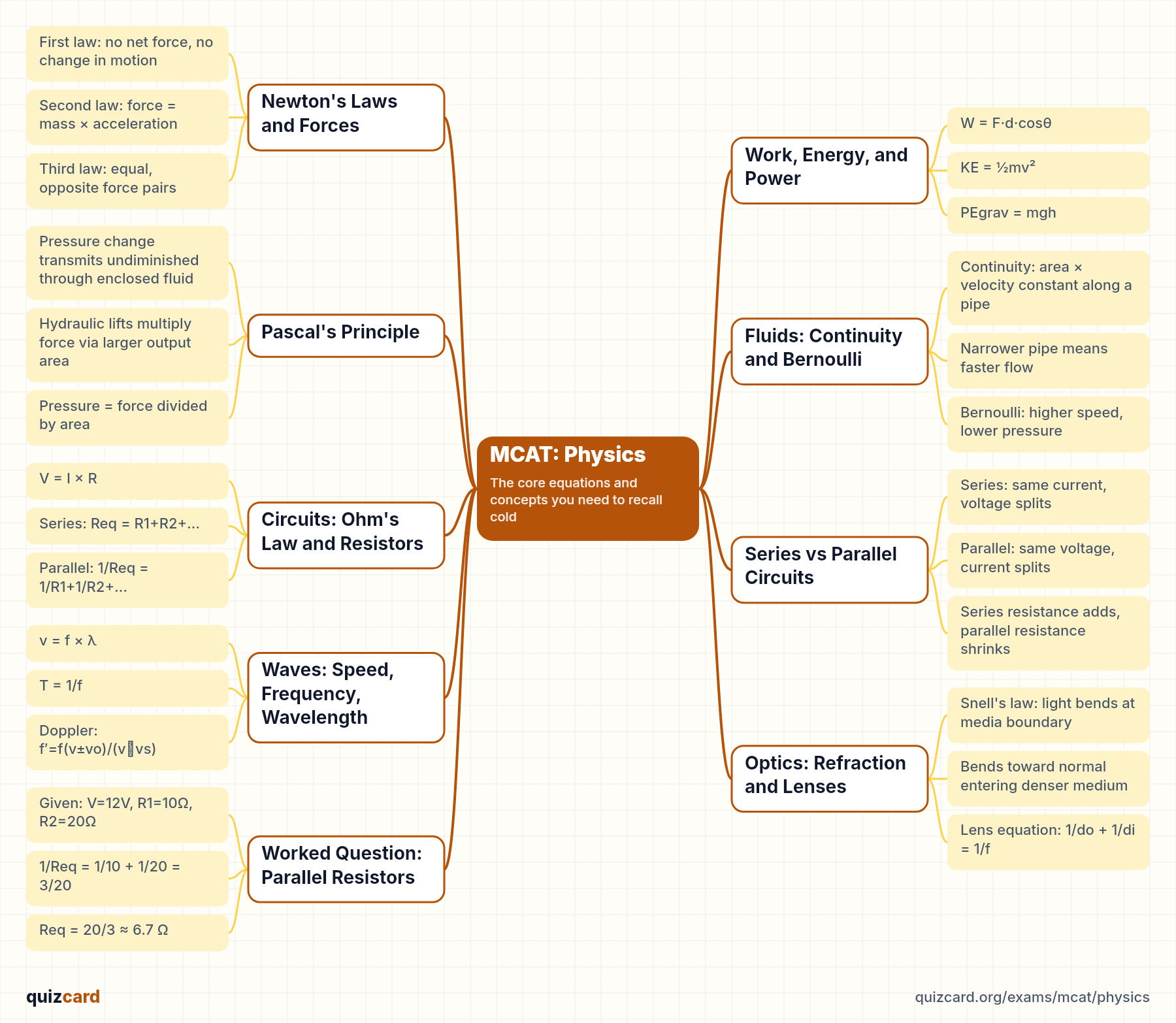
Quick, without looking anything up: what's the difference between work and power, or why a parallel circuit survives a broken bulb when series doesn't? On the MCAT, physics rewards recall, not a reference sheet. This video covers mechanics, fluids, circuits, waves, and optics the way you'll actually need them.
Newton's Laws and Forces
Newton's first law says an object stays at rest or at constant velocity unless a net force acts, so a resting book isn't force-free, it has balanced forces. The second law links them: force equals mass times acceleration. The third law trips people up most: every force has an equal, opposite partner on a different object, like a block pressed against a wall and the wall pushing back.
Key points.
- First law: no net force, no change in motion
- Second law: force = mass × acceleration
- Third law: equal, opposite force pairs
- Free-body diagrams: forces balance at equilibrium
Work, Energy, and Power
Work equals force times displacement times the cosine of the angle between them, so lifting straight up uses the full force since that angle is zero. Kinetic energy is one half mass times velocity squared, and gravitational potential energy is mass times gravity times height. With no friction, energy is conserved: initial kinetic plus potential equals final kinetic plus potential. Power, how fast work gets done, equals work divided by time.
W = F·d·cosθ
KE = ½mv²
PEgrav = mgh
KEi+PEi = KEf+PEf
Power = W/t
Key points.
- Work = force × distance × cos angle
- Kinetic energy = half mass times velocity squared
- Potential energy = mass × gravity × height
- Energy conserved without friction
Pascal's Principle
Pascal's principle is why hydraulic lifts can raise a car with just your hand: press down on a small piston and that pressure change travels undiminished through the fluid to a larger piston, multiplying the force because pressure equals force divided by area, and the area on the output side is bigger. It's also why pressure, not force, is what stays constant throughout a connected, enclosed fluid.
A change in pressure applied to an enclosed fluid is transmitted undiminished to every point of the fluid. Pascal's Principle
Key points.
- Pressure change transmits undiminished through enclosed fluid
- Hydraulic lifts multiply force via larger output area
- Pressure = force divided by area
- Used in brakes, lifts, syringes
Fluids: Continuity and Bernoulli
The continuity equation says flow rate stays constant for an incompressible fluid, so area times velocity is the same everywhere in a pipe, meaning fluid speeds up where the pipe narrows. Bernoulli's equation links that speed to pressure: where velocity is higher, pressure is lower, which is why a narrowed blood vessel has faster, lower-pressure flow. That same pressure drop is how a wing generates lift.
Key points.
- Continuity: area × velocity constant along a pipe
- Narrower pipe means faster flow
- Bernoulli: higher speed, lower pressure
- Explains lift and flow in narrowed vessels
Circuits: Ohm's Law and Resistors
Ohm's law ties voltage, current, and resistance together: voltage equals current times resistance. When resistors are wired in series, their resistances simply add, so current stays the same through each one but voltage splits. In parallel, resistors combine by adding their reciprocals, so total resistance drops below the smallest individual resistor, while voltage stays the same across each branch. Power dissipated is current squared times resistance, or voltage squared divided by resistance.
V = I × R
Series: Req = R1+R2+…
Parallel: 1/Req = 1/R1+1/R2+…
P = I²R = V²/R
Key points.
- Ohm's law: voltage = current × resistance
- Series resistors add directly
- Parallel resistors add as reciprocals
- Power = I² R = V²/R
Series vs Parallel Circuits
In series, current has only one path, so the same current flows through every resistor while voltage splits according to each resistance. In parallel, every branch sees the same voltage, but current divides among branches, and total resistance ends up smaller than the smallest resistor. That's why one broken bulb in series kills the whole string, but in parallel the rest keep working.
Series Circuit
- Same current through each resistor
- Voltage divides across resistors
- Total resistance = sum of resistors
- One break stops the whole circuit
Parallel Circuit
- Same voltage across each branch
- Current divides among branches
- Total resistance less than smallest resistor
- One branch can fail, others still work
Waves: Speed, Frequency, Wavelength
Every wave obeys one relationship: wave speed equals frequency times wavelength. Period is the reciprocal of frequency, the time for one cycle. When a source or observer moves, you get the Doppler effect, which is why a siren sounds higher as it approaches and lower as it pulls away. One key distinction: sound is mechanical and needs a medium, while light is electromagnetic and travels fine through a vacuum.
v = f × λ
T = 1/f
Doppler: f′=f(v±vo)/(v∓vs)
Sound needs medium; light doesn't
Key points.
- Wave speed = frequency × wavelength
- Period = 1/frequency
- Doppler effect shifts pitch with relative motion
- Sound needs a medium, light does not
Optics: Refraction and Lenses
Snell's law governs refraction: light bends according to each medium's index of refraction, bending toward the normal entering a denser medium like glass. The thin lens equation relates object distance, image distance, and focal length: one over object distance plus one over image distance equals one over focal length. A converging lens placed beyond its focal length forms a real, inverted image, just like the eye's lens projecting onto the retina.
Key points.
- Snell's law: light bends at media boundary
- Bends toward normal entering denser medium
- Lens equation: 1/do + 1/di = 1/f
- Converging lens beyond focal length: real, inverted image
Worked Question: Parallel Resistors
Here's a typical question: a 12 volt battery connects to a 10 ohm and a 20 ohm resistor in parallel, and you need the total current from the battery. Combine the resistors first: one over equivalent resistance equals one over 10 plus one over 20, or three over 20, giving an equivalent resistance of about 6.7 ohms. Then apply Ohm's law: current equals voltage over resistance, 12 over 6.7, so roughly 1.8 amps total.
Given: V=12V, R1=10Ω, R2=20Ω
1/Req = 1/10 + 1/20 = 3/20
Req = 20/3 ≈ 6.7 Ω
I = V/Req = 12/6.7 ≈ 1.8 A
Key points.
- Parallel resistors: 10Ω and 20Ω, battery 12V
- Combine: 1/Req = 1/10 + 1/20
- Req ≈ 6.7 Ω
- Current = V/Req ≈ 1.8 A
Remember this
The one thing to remember: every physics passage on the MCAT is just these same handful of equations applied to a new picture. Now quiz yourself on each formula until you can write it down without hesitating.
Practice this unit
- Biology: Cell Structure and Function quiz18 multiple-choice questions with explanations · no account needed
- AP Biology: Genetics and Heredity quiz18 multiple-choice questions with explanations · no account needed
- Chemistry: Atomic Structure and Periodic Trends quiz13 multiple-choice questions with explanations · no account needed
- Biology: Cell Structure and Function30 flashcards · study free
- AP Biology: Genetics and Heredity30 flashcards · study free
- Organic Chemistry: Functional Groups and Reactions30 flashcards · study free
- Chemistry: Stoichiometry and Chemical Reactions30 flashcards · study free
Every MCAT deck and quiz: the MCAT hub.
Other MCAT unit guides
- Biology and biochemistryStudy guide
- CARSStudy guide
- General chemistryStudy guide
- Organic chemistryStudy guide
- Psychology and sociologyStudy guide
Try it with your own material
Upload a PDF, slides or notes and study the deck in minutes. Making your own cards is free with no limits.