MCAT: General chemistry
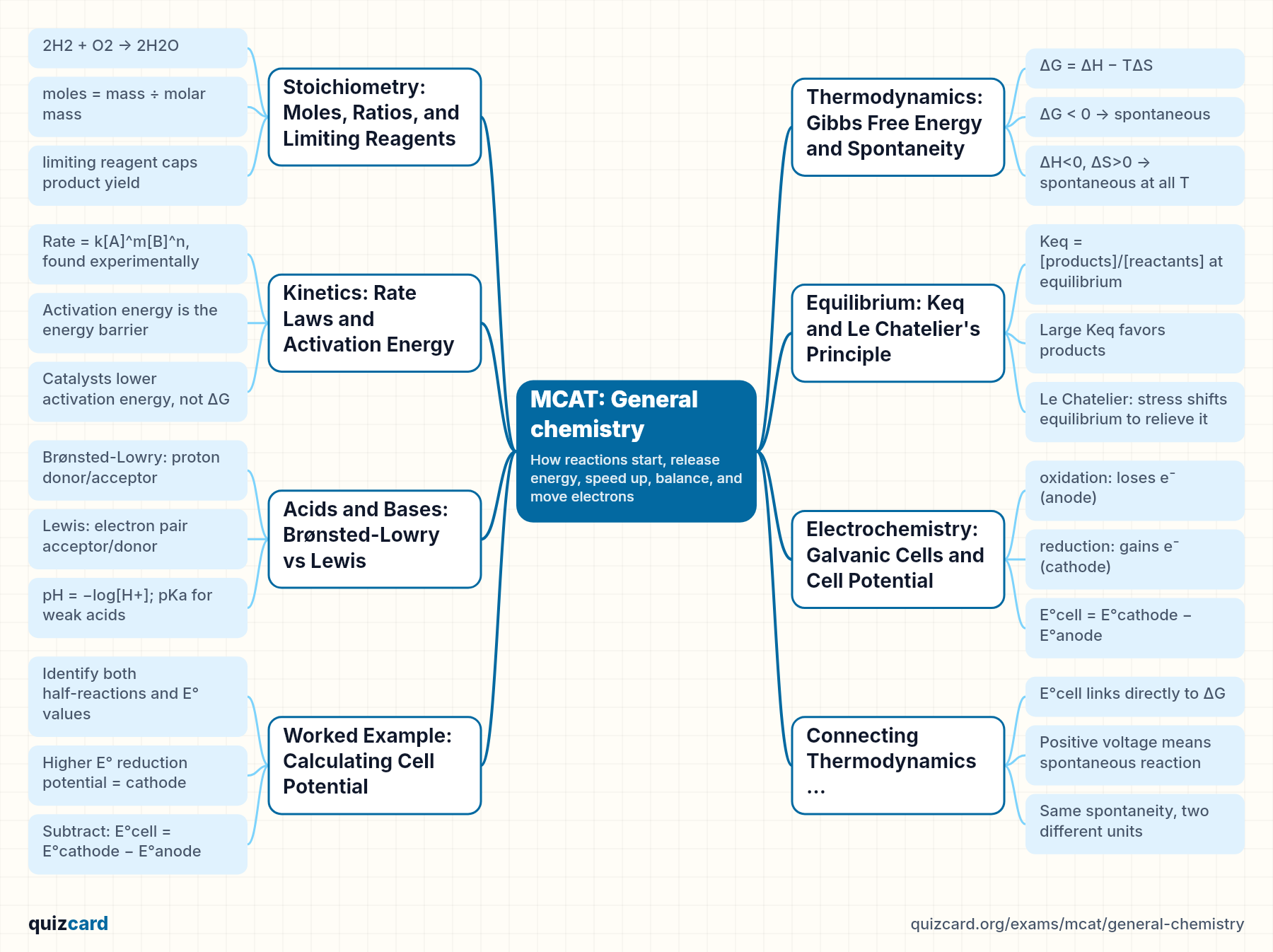
How reactions start, release energy, speed up, balance, and move electrons
On the exam: Stoichiometry, thermodynamics, kinetics, equilibrium, acids and bases, electrochemistry.
Think spontaneous means fast? That's the mistake that costs MCAT test-takers points every year. This video walks through general chemistry the way the exam tests it — stoichiometry, thermodynamics, kinetics, equilibrium, acids and bases, and electrochemistry — then solves a typical question step by step so you see the logic, not just the formula.
Stoichiometry: Moles, Ratios, and Limiting Reagents
Ever notice how one reactant always runs out first in a mixture? That's the limiting reagent. You find it by converting grams to moles with molar mass, then comparing those moles to the ratios in the balanced equation. Mix four moles of hydrogen with one mole of oxygen to make water, and oxygen actually runs out first, even though hydrogen looks plentiful, so it caps how much water you can make.
2H2 + O2 → 2H2O
moles = mass ÷ molar mass
limiting reagent caps product yield
% yield = actual ÷ theoretical × 100
Key points.
- Convert grams to moles using molar mass
- Use balanced equation mole ratios
- Limiting reagent determines maximum product
- Percent yield = actual ÷ theoretical × 100
Thermodynamics: Gibbs Free Energy and Spontaneity
Spontaneous doesn't mean fast — that's the trap. Gibbs free energy tells you direction: delta G equals delta H minus T delta S, and a negative value means the reaction proceeds on its own. An exothermic reaction with rising entropy, like dissolving salt in water, is spontaneous at almost any temperature. But some reactions flip sign as temperature changes, which is why ice melts above zero degrees but not below it.
ΔG = ΔH − TΔS
ΔG < 0 → spontaneous
ΔH<0, ΔS>0 → spontaneous at all T
ΔG° = −RT ln K
Key points.
- ΔG = ΔH − TΔS
- Negative ΔG means spontaneous
- Exothermic plus rising entropy favors spontaneity
- ΔG° = −RT ln K links to equilibrium
Kinetics: Rate Laws and Activation Energy
Kinetics asks how fast, not how far. A rate law, something like rate equals k times concentration of A, must be measured experimentally — you can't read exponents off the balanced equation. On the energy diagram, reactants climb over an activation energy hump to reach the transition state before dropping to products. Catalysts lower that hump, speeding up both directions without changing the reaction's overall energy.
Key points.
- Rate = k[A]^m[B]^n, found experimentally
- Activation energy is the energy barrier
- Catalysts lower activation energy, not ΔG
- Rate constant rises with temperature
Equilibrium: Keq and Le Chatelier's Principle
At equilibrium, forward and reverse rates are equal, not zero. The equilibrium constant, Keq, is products over reactants, each raised to its coefficient — a large Keq means products dominate. Le Chatelier's principle predicts the shift: add more nitrogen to the Haber process, and the system shifts right to make more ammonia; raise the pressure on that same gas mixture, and it shifts toward the side with fewer gas molecules.
Key points.
- Keq = [products]/[reactants] at equilibrium
- Large Keq favors products
- Le Chatelier: stress shifts equilibrium to relieve it
- ICE tables track changing concentrations
Acids and Bases: Brønsted-Lowry vs Lewis
Brønsted-Lowry acids donate a proton, bases accept one — that's how you spot conjugate pairs. Lewis acids and bases go broader: an acid accepts an electron pair, a base donates one, so boron trifluoride counts as an acid with no proton involved. For strength, pH equals negative log of hydrogen ion concentration, and Henderson-Hasselbalch gives a buffer's pH as pKa plus log of base over acid.
Brønsted-Lowry
- Acid donates a proton (H+)
- Base accepts a proton
- Defines conjugate acid-base pairs
Lewis
- Acid accepts an electron pair
- Base donates an electron pair
- Explains reactions with no protons, like BF3
Electrochemistry: Galvanic Cells and Cell Potential
In a galvanic cell, oxidation happens at the anode, reduction at the cathode, and the whole reaction runs spontaneously. You find standard cell potential by subtracting the anode's reduction potential from the cathode's: E cell equals E cathode minus E anode. That potential links to free energy through delta G equals negative n F E, and when concentrations aren't standard, the Nernst equation adjusts the voltage for you.
oxidation: loses e⁻ (anode)
reduction: gains e⁻ (cathode)
E°cell = E°cathode − E°anode
ΔG = −nFE°cell
E = E° − (RT/nF) ln Q
Key points.
- Oxidation at anode, reduction at cathode
- E°cell = E°cathode − E°anode
- ΔG = −nFE°cell links energy and voltage
- Nernst equation adjusts for nonstandard conditions
Worked Example: Calculating Cell Potential
Here's a typical question: copper two plus reduces at plus zero point three four volts, zinc two plus reduces at negative zero point seven six volts — find the cell potential. Copper's potential is higher, so it's the cathode; zinc gets oxidized at the anode. Subtract: zero point three four minus negative zero point seven six gives one point one zero volts, positive, confirming the reaction runs spontaneously as written.
- Identify half-reactions and their E° values
- Determine cathode (reduction) and anode (oxidation)
- Subtract: E°cell = E°cathode − E°anode
- Check sign: positive E° means spontaneous
- Use ΔG = −nFE° if asked for free energy
Connecting Thermodynamics and Electrochemistry
That one point one zero volts isn't a number to memorize — it's the same spontaneity from thermodynamics, just measured electrically. A positive cell potential always matches a negative delta G, so seeing voltage lets you predict direction without touching a single joule. Keep that link in mind, because questions on this unit love combining both ideas at once.
1.10 V Standard voltage of the zinc-copper cell — spontaneous, just as a negative ΔG predicts
Key points.
- E°cell links directly to ΔG
- Positive voltage means spontaneous reaction
- Same spontaneity, two different units
Remember this
The thread through all of general chemistry is simple: does a reaction want to happen, and how fast does it get there. Quiz yourself until you can derive these formulas, not just recall them — that's what the MCAT rewards.
Practice this unit
- Biology: Cell Structure and Function quiz18 multiple-choice questions with explanations · no account needed
- AP Biology: Genetics and Heredity quiz18 multiple-choice questions with explanations · no account needed
- Chemistry: Atomic Structure and Periodic Trends quiz13 multiple-choice questions with explanations · no account needed
- Biology: Cell Structure and Function30 flashcards · study free
- AP Biology: Genetics and Heredity30 flashcards · study free
- Organic Chemistry: Functional Groups and Reactions30 flashcards · study free
- Chemistry: Stoichiometry and Chemical Reactions30 flashcards · study free
Every MCAT deck and quiz: the MCAT hub.
Other MCAT unit guides
- Biology and biochemistryStudy guide
- CARSStudy guide
- Organic chemistryStudy guide
- PhysicsStudy guide
- Psychology and sociologyStudy guide
Try it with your own material
Upload a PDF, slides or notes and study the deck in minutes. Making your own cards is free with no limits.