Exam prep · AP Chemistry · Unit guide
AP Chemistry Unit 7: Equilibrium
How to write K, compare Q to K, apply Le Châtelier, and solve Ksp problems
On the exam: 7 to 9%. K, Q, Le Châtelier, solubility.
Think equilibrium means the reactant and product concentrations become equal? That's the single most common mix-up in AP Chemistry's equilibrium unit, and it costs real points. This video covers what equilibrium actually means, how to write the equilibrium constant, how Q tells you which way a reaction shifts, Le Châtelier's principle, a full worked ICE table problem, and solubility equilibria with Ksp.
What Equilibrium Really Means
Equilibrium does not mean the reaction stopped, and it does not mean reactants and products end up at the same concentration. It means the forward rate and the reverse rate have become equal, so concentrations stop changing. Take nitrogen plus hydrogen forming ammonia: molecules of ammonia are still breaking apart and reforming constantly, the amounts just hold steady because both directions happen at the same rate.
At equilibrium, the forward and reverse reaction rates are equal, so concentrations remain constant over time. Dynamic equilibrium, AP Chemistry
Key points.
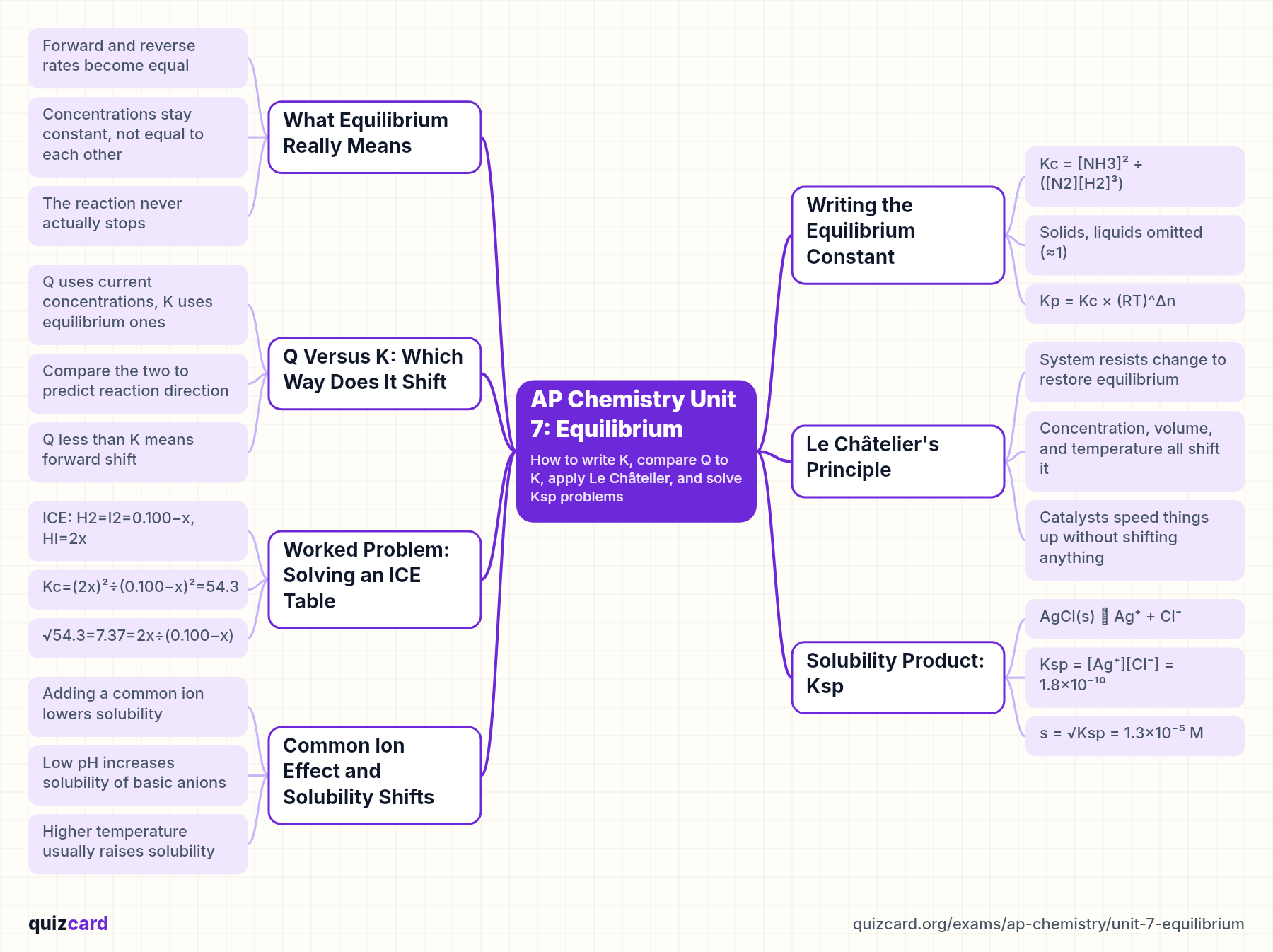
- Forward and reverse rates become equal
- Concentrations stay constant, not equal to each other
- The reaction never actually stops
- Only applies to closed systems
Writing the Equilibrium Constant
For nitrogen plus three hydrogen going to two ammonia, you write Kc as the concentration of ammonia squared, divided by the concentration of nitrogen times hydrogen cubed. Pure solids and liquids never appear in the expression, since their concentrations don't change. If your reaction involves gases and you're given pressures instead, you can convert using Kp equals Kc times R T raised to the power of delta n, the change in moles of gas.
Kc = [NH3]² ÷ ([N2][H2]³)
Solids, liquids omitted (≈1)
Kp = Kc × (RT)^Δn
Key points.
- Products over reactants, each raised to its coefficient
- Pure solids and liquids are left out
- Kc uses concentrations, Kp uses partial pressures
- Kp equals Kc times R T to the power delta n
Q Versus K: Which Way Does It Shift
Q, the reaction quotient, has the exact same form as K, but you plug in whatever concentrations you have right now, not necessarily at equilibrium. Comparing Q to K tells you where the system is headed. If Q is smaller than K, there's not enough product yet, so the reaction runs forward. If Q is bigger than K, there's too much product, so it runs in reverse until Q catches up to K.
Q less than K
- Too little product so far
- Reaction shifts forward
- Net formation of products
Q greater than K
- Too much product already
- Reaction shifts in reverse
- Net formation of reactants
Le Châtelier's Principle
Le Châtelier's principle says that if you stress a system at equilibrium, it shifts to partially counteract that stress. Add more reactant, and the system shifts toward products to use some of it up. Decrease the container's volume, raising pressure, and gas-phase equilibria shift toward the side with fewer moles of gas. Raise the temperature, and the system shifts in whichever direction absorbs that heat, the endothermic direction. A catalyst changes nothing about the position of equilibrium, it only gets you there faster.
- Add reactant: shifts toward products
- Remove product: shifts toward products
- Raise pressure (lower volume): shifts toward fewer gas moles
- Raise temperature: shifts toward endothermic side
- Catalyst: speeds up both rates, no shift
Worked Problem: Solving an ICE Table
Here's a typical setup. Hydrogen gas plus iodine gas goes to two H I, with Kc equal to fifty four point three. You start with zero point one zero zero molar of each reactant and no product. In the ICE table, both reactants become zero point one zero zero minus x, and the product becomes two x. Plugging into Kc and taking the square root of both sides gives seven point three seven equals two x over zero point one zero zero minus x. Solving gives x equals zero point zero seven eight six, so H2 and I2 each end up at zero point zero two one four molar, and H I ends up at zero point one five seven molar.
ICE: H2=I2=0.100−x, HI=2x
Kc=(2x)²÷(0.100−x)²=54.3
√54.3=7.37=2x÷(0.100−x)
x=0.0786 M
[H2]=[I2]=0.0214 M
[HI]=0.157 M
Key points.
- Set up initial, change, and equilibrium rows
- Plug equilibrium row into the K expression
- Take the square root when the setup allows it
- Solve for x, then find each concentration
Solubility Product: Ksp
For a sparingly soluble salt like silver chloride, the solid breaks into silver ion and chloride ion, and Ksp equals the concentration of silver ion times the concentration of chloride ion. If Ksp is one point eight times ten to the negative ten, and each ion comes from one formula unit, then both concentrations equal the molar solubility, s. So Ksp equals s squared, and solving gives s equals one point three times ten to the negative five molar, a very small number, which is exactly why we call it slightly soluble.
AgCl(s) ⇌ Ag⁺ + Cl⁻
Ksp = [Ag⁺][Cl⁻] = 1.8×10⁻¹⁰
s = √Ksp = 1.3×10⁻⁵ M
Key points.
- Ksp applies to slightly soluble ionic solids
- Write it as product of ion concentrations
- Solubility s links directly back to Ksp
- Molar solubility can be calculated from Ksp alone
Common Ion Effect and Solubility Shifts
Solubility isn't fixed, it responds to the same Le Châtelier logic. Add sodium chloride to a saturated silver chloride solution, and the extra chloride ion pushes the equilibrium back toward solid, lowering silver chloride's solubility, this is the common ion effect. Salts of weak acids, like carbonates, dissolve better in acidic solution because the extra hydrogen ion removes the anion. And just like with Q and K, if the calculated Qsp exceeds Ksp, a precipitate forms.
Key points.
- Adding a common ion lowers solubility
- Low pH increases solubility of basic anions
- Higher temperature usually raises solubility
- Compare Qsp to Ksp to predict precipitation
Remember this
The one thing to remember is that equilibrium is dynamic, not static, and comparing Q to K always tells you which direction a reaction needs to shift. Before your AP Chemistry exam, quiz yourself on writing K expressions, predicting shifts with Le Châtelier, and working through an ICE table from scratch.
Practice this unit
- Chemistry: Atomic Structure and Periodic Trends quiz13 multiple-choice questions with explanations · no account needed
- AP Chemistry: Kinetics, Thermochemistry and Electrochemistry quiz15 multiple-choice questions with explanations · no account needed
- AP Chemistry: Equilibrium, Acids and Bases quiz15 multiple-choice questions with explanations · no account needed
- Chemistry: Atomic Structure and Periodic Trends30 flashcards · study free
- Chemistry: Stoichiometry and Chemical Reactions30 flashcards · study free
- AP Chemistry: Kinetics, Thermochemistry and Electrochemistry34 flashcards · study free
- AP Chemistry: Equilibrium, Acids and Bases36 flashcards · study free
Every AP Chemistry deck and quiz: the AP Chemistry hub.
Other AP Chemistry unit guides
- Unit 1: Atomic Structure and PropertiesStudy guide
- Unit 2: Compound Structure and PropertiesStudy guide
- Unit 3: Properties of Substances and MixturesGuide + video lesson
- Unit 4: Chemical ReactionsGuide + video lesson
- Unit 5: KineticsStudy guide
- Unit 6: ThermochemistryStudy guide
- Unit 8: Acids and BasesStudy guide
- Unit 9: Thermodynamics and ElectrochemistryStudy guide
Try it with your own material
Upload a PDF, slides or notes and study the deck in minutes. Making your own cards is free with no limits.