Exam prep · AP Chemistry · Unit guide
AP Chemistry Unit 4: Chemical Reactions
Reaction types, net ionic equations, stoichiometry, and titration explained clearly.
On the exam: 7 to 9%. Net ionic equations, stoichiometry, titration, reaction types.
What's the one thing students get wrong on net ionic equations in AP Chemistry? Forgetting to cancel spectator ions. This video walks through reaction types, net ionic equations, stoichiometry, limiting reactant, and titration, then works a full practice question step by step.
Watch the lesson
Watch on YouTube · 30-second version
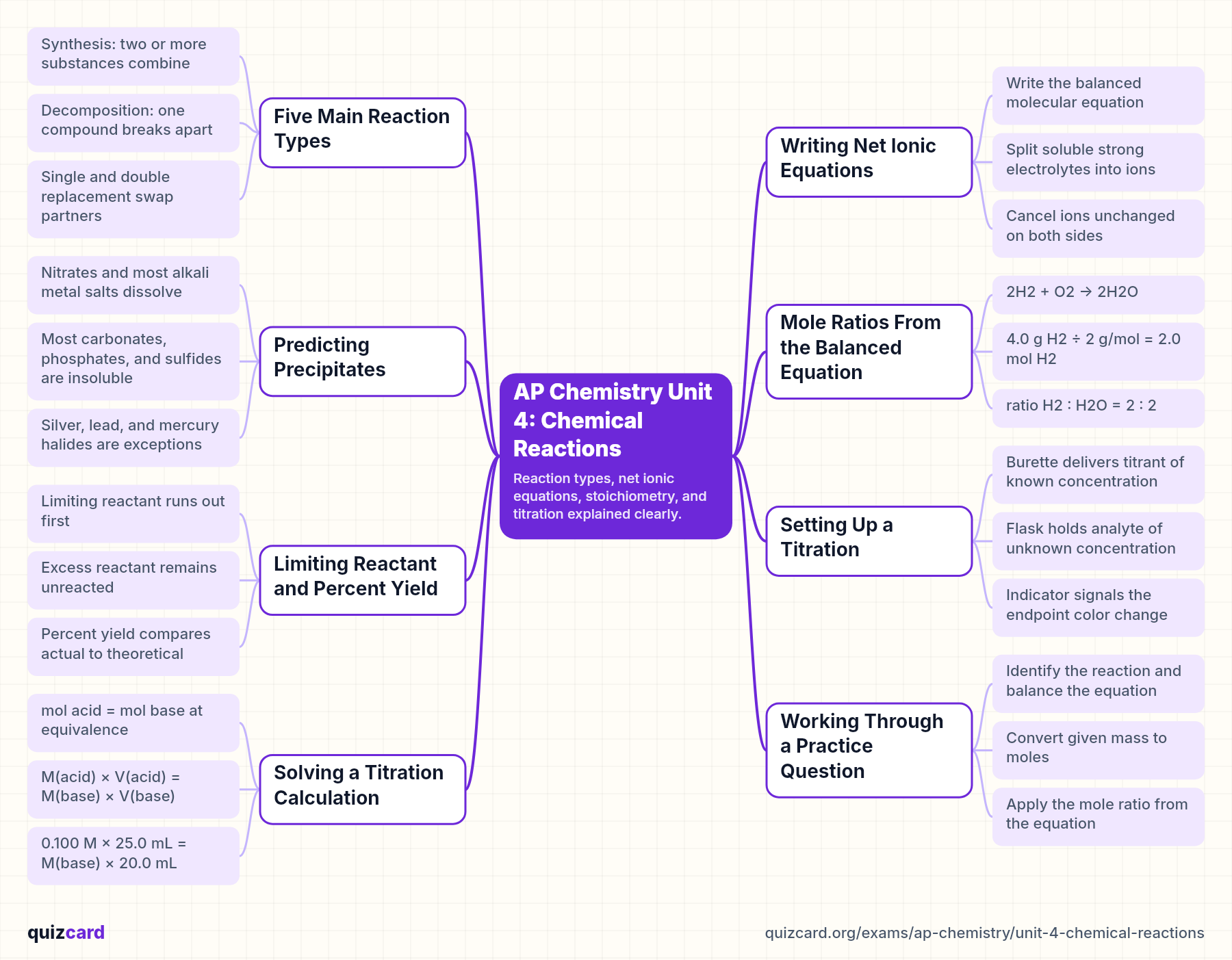
Five Main Reaction Types
Chemical reactions fall into patterns you will recognize again and again. Synthesis joins two substances into one, like hydrogen and oxygen forming water. Decomposition does the opposite, breaking one compound into pieces. Single replacement swaps one element into a compound, while double replacement swaps ions between two compounds, often producing a precipitate, a gas, or water. Combustion burns a fuel with oxygen to make carbon dioxide and water.
Key points.
- Synthesis: two or more substances combine
- Decomposition: one compound breaks apart
- Single and double replacement swap partners
- Combustion: fuel plus oxygen forms carbon dioxide and water
Writing Net Ionic Equations
Start with the balanced molecular equation, say silver nitrate plus sodium chloride. Rewrite every soluble strong electrolyte as separate ions, since that is how they actually exist in water. Then find the ions that appear unchanged on both sides, sodium and nitrate here, and cancel them out. They are called spectator ions because they do not actually react. What is left, silver ion plus chloride ion forming solid silver chloride, is the net ionic equation.
- Write the balanced molecular equation
- Split soluble strong electrolytes into ions
- Cancel ions that appear unchanged on both sides
- What's left is the net ionic equation
Predicting Precipitates
To predict whether a precipitate forms, you lean on solubility rules. Nearly everything with sodium, potassium, or ammonium dissolves, and so do nitrates. But most carbonates, phosphates, and sulfides are insoluble, and silver, lead, and mercury halides break the usual halide rule and sink to the bottom too. So when you mix lead nitrate with potassium iodide, lead and iodide combine into solid lead iodide, a bright yellow precipitate, while potassium and nitrate stay dissolved.
Key points.
- Nitrates and most alkali metal salts dissolve
- Most carbonates, phosphates, and sulfides are insoluble
- Silver, lead, and mercury halides are exceptions
- Mixing solutions can form an insoluble solid
Mole Ratios From the Balanced Equation
Stoichiometry always starts with a balanced equation, because the coefficients give you mole ratios. Take hydrogen burning in oxygen: two moles of hydrogen react with one mole of oxygen to give two moles of water. If you start with four grams of hydrogen, that is two moles, using a molar mass of two grams per mole. Since the ratio of hydrogen to water is one to one, you also get two moles of water, which is thirty six grams.
2H2 + O2 → 2H2O
4.0 g H2 ÷ 2 g/mol = 2.0 mol H2
ratio H2 : H2O = 2 : 2
2.0 mol H2 → 2.0 mol H2O
2.0 mol × 18 g/mol = 36 g H2O
Key points.
- Balanced equation gives mole ratios
- Convert grams to moles first
- Use the ratio to find moles of product
- Convert back to grams if needed
Limiting Reactant and Percent Yield
Not every reactant gets used up at the same time. The limiting reactant is the one that runs out first and caps how much product you can make, while the excess reactant is left over. To find it, divide moles of each reactant by its coefficient and the smaller ratio wins. Once you know the theoretical yield, you compare it to what you actually collected in lab to get percent yield, actual over theoretical times one hundred.
Limiting Reactant
- Runs out first
- Determines how much product forms
- Found from the smallest mole ratio
Excess Reactant
- Left over after the reaction
- Does not limit product amount
- Used to find leftover mass
Setting Up a Titration
In a titration, you slowly add a solution of known concentration, the titrant, from a burette into a flask holding the solution you are trying to measure, the analyte. An indicator changes color near the point where moles of acid exactly equal moles of base, the equivalence point. For a strong acid and strong base, phenolphthalein often marks this moment, turning from clear to pink the instant the last drop neutralizes the solution.
Key points.
- Burette delivers titrant of known concentration
- Flask holds analyte of unknown concentration
- Indicator signals the endpoint color change
- Equivalence point: moles acid equal moles base
Solving a Titration Calculation
At the equivalence point, moles of acid equal moles of base, so molarity times volume on one side equals molarity times volume on the other. Say twenty five milliliters of zero point one zero zero molar hydrochloric acid gets neutralized by twenty milliliters of sodium hydroxide. Setting those equal and solving, the sodium hydroxide concentration comes out to zero point one two five molar. Just remember to keep your volumes in consistent units before you divide.
mol acid = mol base at equivalence
M(acid) × V(acid) = M(base) × V(base)
0.100 M × 25.0 mL = M(base) × 20.0 mL
M(base) = 0.125 M
Key points.
- At equivalence, moles acid equal moles base
- Use molarity times volume for each solution
- Solve for the unknown concentration
- Keep volumes in consistent units
Working Through a Practice Question
Here's a typical question: thirty two grams of calcium carbonate react with excess hydrochloric acid, producing calcium chloride, water, and carbon dioxide. Using the molar mass of one hundred grams per mole gives zero point three two moles of calcium carbonate. The one to one mole ratio means you also get zero point three two moles of carbon dioxide, which at twenty two point four liters per mole is about seven point two liters.
- Identify reaction type and write balanced equation
- Convert given mass to moles
- Apply mole ratio from the equation
- Convert moles back to the requested unit
- Check significant figures and units
Remember this
The one thing to remember: always balance your equation and track moles before grams, whether you are predicting products, titrating, or writing net ionic equations. Now quiz yourself on a few reaction types and a titration problem to make sure it sticks.
Practice this unit
- Chemistry: Atomic Structure and Periodic Trends quiz13 multiple-choice questions with explanations · no account needed
- AP Chemistry: Kinetics, Thermochemistry and Electrochemistry quiz15 multiple-choice questions with explanations · no account needed
- AP Chemistry: Equilibrium, Acids and Bases quiz15 multiple-choice questions with explanations · no account needed
- Chemistry: Atomic Structure and Periodic Trends30 flashcards · study free
- Chemistry: Stoichiometry and Chemical Reactions30 flashcards · study free
- AP Chemistry: Kinetics, Thermochemistry and Electrochemistry34 flashcards · study free
- AP Chemistry: Equilibrium, Acids and Bases36 flashcards · study free
Every AP Chemistry deck and quiz: the AP Chemistry hub.
Other AP Chemistry unit guides
- Unit 1: Atomic Structure and PropertiesStudy guide
- Unit 2: Compound Structure and PropertiesStudy guide
- Unit 3: Properties of Substances and MixturesGuide + video lesson
- Unit 5: KineticsStudy guide
- Unit 6: ThermochemistryStudy guide
- Unit 7: EquilibriumStudy guide
- Unit 8: Acids and BasesStudy guide
- Unit 9: Thermodynamics and ElectrochemistryStudy guide
Try it with your own material
Upload a PDF, slides or notes and study the deck in minutes. Making your own cards is free with no limits.