Exam prep · AP Chemistry · Unit guide
AP Chemistry Unit 6: Thermochemistry
How heat flows in reactions, how to measure it, and how to calculate ΔH every way AP asks.
On the exam: 7 to 9%. Enthalpy, calorimetry, Hess’s law.
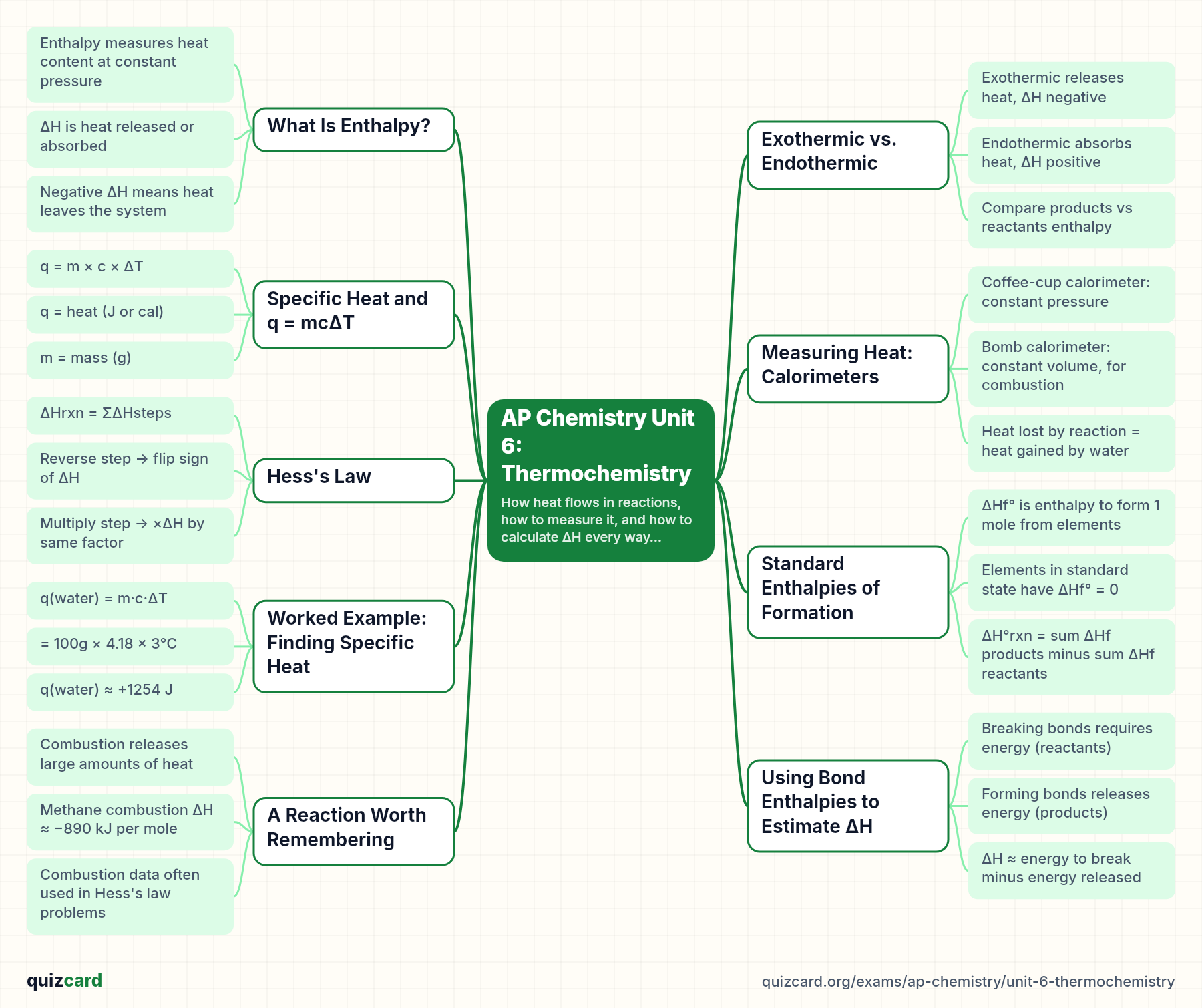
Think you can just add up delta H values without checking directions and coefficients? That's the biggest point-loss on AP Chemistry thermochemistry questions. This video covers what enthalpy measures, how calorimeters capture it, how Hess's law builds new reactions from old ones, and a full worked calorimetry problem.
What Is Enthalpy?
Here's something almost everyone mixes up at first: enthalpy isn't energy, it's heat measured at constant pressure. We call it H, and what you actually track in a reaction is the change, delta H. If delta H is negative, the reaction is giving off heat to the surroundings. If it's positive, the reaction is pulling heat in. That sign is the whole story.
Enthalpy, H, is the heat content of a system at constant pressure; ΔH is the heat flow of a reaction. AP Chemistry definition
Key points.
- Enthalpy measures heat content at constant pressure
- ΔH is heat released or absorbed
- Negative ΔH means heat leaves the system
- Positive ΔH means heat enters the system
Exothermic vs. Endothermic
Reactions either give off heat or take it in, and this is tested constantly from graphs or signs. In an exothermic reaction, like methane burning, the products end up lower in enthalpy than the reactants, so delta H is negative and the surroundings warm up. In an endothermic reaction, like ice melting, the products sit higher in enthalpy, delta H is positive, and the surroundings cool down.
Exothermic
- Releases heat to surroundings
- ΔH is negative
- Surroundings feel warmer
- Example: combustion of methane
Endothermic
- Absorbs heat from surroundings
- ΔH is positive
- Surroundings feel colder
- Example: photosynthesis, melting ice
Specific Heat and q = mcΔT
Now for the equation you'll use constantly in calorimetry: q equals m times c times delta T. Here q is the heat transferred, m is the mass of the substance in grams, c is its specific heat capacity, and delta T is the final temperature minus the initial temperature. Water's specific heat is four point one eight joules per gram degree Celsius, which is why water resists temperature change so well.
q = m × c × ΔT
q = heat (J or cal)
m = mass (g)
c = specific heat (J/g·°C)
ΔT = Tfinal − Tinitial
Key points.
- q = m times c times delta T
- q is heat transferred in joules
- c is specific heat capacity
- Water's c is 4.18 J per gram per degree C
Measuring Heat: Calorimeters
To measure q in the lab, chemists use calorimeters. A coffee cup calorimeter, just two nested foam cups with a lid and a thermometer, measures heat at constant pressure, so the heat released by the reaction equals the heat absorbed by the water inside. A bomb calorimeter is a sealed steel container that holds reactions at constant volume, used for combustion, where pressure builds up.
Key points.
- Coffee-cup calorimeter: constant pressure
- Bomb calorimeter: constant volume, for combustion
- Heat lost by reaction = heat gained by water
- Assumes no heat escapes to surroundings
Hess's Law
Hess's law says enthalpy is a state function, so it doesn't matter how many steps you take from reactants to products, the total enthalpy change stays the same. That means you can add a series of reactions to build the one you want. Reverse a given reaction and you flip the sign of its delta H. Multiply a reaction by two and you multiply its delta H by two as well.
ΔHrxn = ΣΔHsteps
Reverse step → flip sign of ΔH
Multiply step → ×ΔH by same factor
Add steps, cancel intermediates
Key points.
- Enthalpy is a state function
- Add steps, cancel intermediates to get target reaction
- Reverse a reaction flips sign of ΔH
- Scale a reaction scales ΔH by same factor
Standard Enthalpies of Formation
Every compound has a standard enthalpy of formation, delta H f standard, the enthalpy change when one mole of it forms from its elements in their standard states. An element in its standard state has a delta H f of zero. To find the enthalpy of any reaction, take the sum of delta H f of the products minus the sum of delta H f of the reactants, each multiplied by its coefficient.
Key points.
- ΔHf° is enthalpy to form 1 mole from elements
- Elements in standard state have ΔHf° = 0
- ΔH°rxn = sum ΔHf products minus sum ΔHf reactants
- Multiply each ΔHf by its coefficient
Worked Example: Finding Specific Heat
A fifty gram metal at one hundred degrees drops into water at twenty two degrees, settling at twenty five. Heat gained by water: mass times specific heat times delta T, one hundred grams times four point one eight times three degrees, about twelve fifty four joules. The metal loses it; dividing by its mass and the seventy five degree drop gives a specific heat near zero point three three joules per gram degree.
q(water) = m·c·ΔT
= 100g × 4.18 × 3°C
q(water) ≈ +1254 J
q(metal) = −1254 J
c = q / (m×ΔT)
c ≈ 1254/(50×75) ≈ 0.33 J/g·°C
Key points.
- Heat gained by water = mass × c × ΔT
- q(water) ≈ 1254 J, so q(metal) = −1254 J
- Solve c = q / (m × ΔT) for metal
- c(metal) ≈ 0.33 J/g·°C
Using Bond Enthalpies to Estimate ΔH
When you don't have formation data, you can estimate delta H using average bond enthalpies. Breaking bonds always costs energy, so you add up the energy needed to break every bond in the reactants. Forming bonds always releases energy, so you add the energy released forming every bond in the products. Delta H is roughly energy to break minus energy released forming new bonds; a positive value means the reaction is endothermic.
- Add bond enthalpies of bonds broken in reactants
- Add bond enthalpies of bonds formed in products
- ΔH ≈ bonds broken minus bonds formed
- Positive result means net energy input (endothermic)
A Reaction Worth Remembering
Combustion reactions are a favorite example because they're so exothermic. Burning one mole of methane gas releases about eight hundred ninety kilojoules of heat, which is why delta H for combustion reactions is always a large negative number. Numbers like this show up constantly in Hess's law problems, since combustion data is one of the most common pieces given to combine into a target reaction.
-890 kJ Enthalpy released per mole of methane burned completely in oxygen
Key points.
- Combustion releases large amounts of heat
- Methane combustion ΔH ≈ −890 kJ per mole
- Combustion data often used in Hess's law problems
- Large negative ΔH signals strongly exothermic reaction
Remember this
The one thing to remember: enthalpy change depends only on start and end states, never on the path, which is exactly why Hess's law works. Now quiz yourself on these calculations before your AP Chemistry unit test.
Practice this unit
- Chemistry: Atomic Structure and Periodic Trends quiz13 multiple-choice questions with explanations · no account needed
- AP Chemistry: Kinetics, Thermochemistry and Electrochemistry quiz15 multiple-choice questions with explanations · no account needed
- AP Chemistry: Equilibrium, Acids and Bases quiz15 multiple-choice questions with explanations · no account needed
- Chemistry: Atomic Structure and Periodic Trends30 flashcards · study free
- Chemistry: Stoichiometry and Chemical Reactions30 flashcards · study free
- AP Chemistry: Kinetics, Thermochemistry and Electrochemistry34 flashcards · study free
- AP Chemistry: Equilibrium, Acids and Bases36 flashcards · study free
Every AP Chemistry deck and quiz: the AP Chemistry hub.
Other AP Chemistry unit guides
- Unit 1: Atomic Structure and PropertiesStudy guide
- Unit 2: Compound Structure and PropertiesStudy guide
- Unit 3: Properties of Substances and MixturesGuide + video lesson
- Unit 4: Chemical ReactionsGuide + video lesson
- Unit 5: KineticsStudy guide
- Unit 7: EquilibriumStudy guide
- Unit 8: Acids and BasesStudy guide
- Unit 9: Thermodynamics and ElectrochemistryStudy guide
Try it with your own material
Upload a PDF, slides or notes and study the deck in minutes. Making your own cards is free with no limits.