Exam prep · AP Chemistry · Unit guide
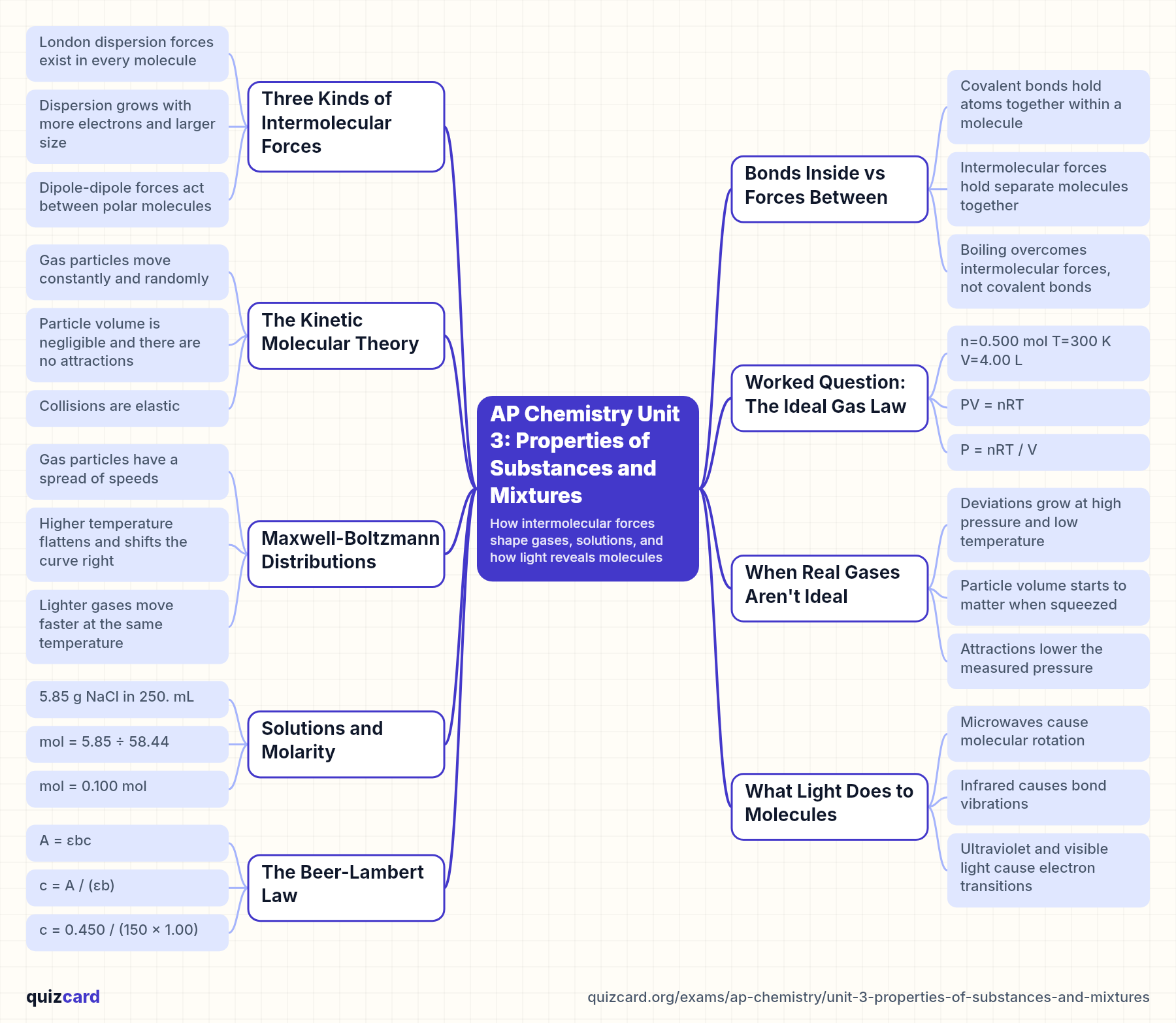
AP Chemistry Unit 3: Properties of Substances and Mixtures
How intermolecular forces shape gases, solutions, and how light reveals molecules
On the exam: 18 to 22%. Intermolecular forces, gases, solutions, spectroscopy.
Does a covalent bond in water break when it boils? If you said yes, you're in good company, and that's the mix-up this video fixes. For your chemistry course, we'll cover intermolecular forces, gases, solutions and spectroscopy, and work through a classic gas law problem together.
Watch the lesson
Watch on YouTube · 30-second version
Three Kinds of Intermolecular Forces
Intermolecular forces are the attractions between separate molecules. London dispersion forces exist in every molecule, and they grow stronger as the number of electrons increases, which is why iodine is a solid at room temperature while fluorine is a gas. Dipole-dipole forces act between polar molecules. Hydrogen bonding is an especially strong dipole attraction that appears when hydrogen is bonded to nitrogen, oxygen or fluorine.
Key points.
- London dispersion forces exist in every molecule
- Dispersion grows with more electrons and larger size
- Dipole-dipole forces act between polar molecules
- Hydrogen bonding needs H bonded to N, O or F
Bonds Inside vs Forces Between
Here's the distinction students trip over most. When water boils, the oxygen hydrogen bonds inside each molecule stay completely intact. You're only pulling whole molecules away from each other. Covalent bonds hold atoms together within a molecule, and breaking them takes hundreds of kilojoules per mole. Intermolecular forces are much weaker, and they're what control physical properties like boiling point, vapor pressure, viscosity and surface tension.
Intramolecular bonds
- Hold atoms within one molecule
- Covalent, ionic or metallic
- Broken in chemical changes
- Much stronger
Intermolecular forces
- Attract separate molecules
- Dispersion, dipole, hydrogen bonding
- Overcome in phase changes
- Much weaker
The Kinetic Molecular Theory
To understand gases, we use the kinetic molecular theory. It pictures gas particles in constant, random motion, with a volume so small compared to the container that we can ignore it. The particles don't attract or repel each other, and their collisions are elastic, so no energy is lost. Most importantly, the average kinetic energy of the particles depends only on the Kelvin temperature.
The average kinetic energy of gas particles is directly proportional to the Kelvin temperature. Kinetic molecular theory
Key points.
- Gas particles move constantly and randomly
- Particle volume is negligible and there are no attractions
- Collisions are elastic
- Average kinetic energy is proportional to Kelvin temperature
Worked Question: The Ideal Gas Law
Here's a typical question. A sample of zero point five zero zero moles of gas sits in a four point zero zero liter container at three hundred kelvin, so what's the pressure? We start with P V equals n R T. Then we rearrange to get P equals n R T over V. Plugging in gives zero point five times zero point zero eight two zero six times three hundred, over four. That's twelve point three over four, so the pressure is about three point zero eight atmospheres.
n=0.500 mol  T=300 K  V=4.00 L
PV = nRT
P = nRT / V
P = (0.500)(0.08206)(300)/4.00
P = 12.3 / 4.00
P ≈ 3.08 atm
Key points.
- Identify n, T and V from the question
- Rearrange PV = nRT to solve for P
- Use R = 0.08206 L·atm/(mol·K) for atmospheres
- The answer is about 3.08 atm
Maxwell-Boltzmann Distributions
Not every particle in a gas moves at the same speed. A Maxwell-Boltzmann distribution plots how many particles have each speed. When you raise the temperature, the curve flattens and shifts to the right, because more particles move faster. At the same temperature, a lighter gas like helium has a broader curve shifted to higher speeds than a heavier gas like nitrogen, even though their average kinetic energies match.
Key points.
- Gas particles have a spread of speeds
- Higher temperature flattens and shifts the curve right
- Lighter gases move faster at the same temperature
- Area under each curve stays the same
When Real Gases Aren't Ideal
Real gases behave most ideally at low pressure and high temperature. At high pressure, particles are crowded together, so their own volume is no longer negligible. At low temperature, particles move slowly enough that intermolecular attractions pull them together, and they hit the walls less forcefully, so the measured pressure comes out lower than predicted. That's why a polar gas like ammonia deviates more than helium does.
Key points.
- Deviations grow at high pressure and low temperature
- Particle volume starts to matter when squeezed
- Attractions lower the measured pressure
- Polar, large molecules deviate most; helium deviates least
Solutions and Molarity
Solutions form when solute and solvent attractions are similar, which is why we say like dissolves like. To describe concentration, we use molarity. Say you dissolve five point eight five grams of sodium chloride to make two hundred fifty milliliters of solution. First, divide by the molar mass of fifty eight point four four, which gives zero point one zero zero moles. Molarity is moles over liters, so zero point one over zero point two five is zero point four zero zero molar.
5.85 g NaCl in 250. mL
mol = 5.85 ÷ 58.44
mol = 0.100 mol
M = mol solute / L solution
M = 0.100 / 0.250
M = 0.400 M
Key points.
- Like dissolves like: polar with polar, nonpolar with nonpolar
- Molarity is moles of solute per liter of solution
- Convert grams to moles with molar mass first
- 5.85 g NaCl in 250. mL gives 0.400 M
What Light Does to Molecules
Spectroscopy works because different kinds of light cause different changes in molecules. Microwave radiation makes molecules rotate. Infrared radiation makes bonds vibrate, stretching and bending. Ultraviolet and visible light carry enough energy to move electrons between energy levels. The pattern follows from photon energy: energy equals Planck's constant times frequency, so shorter wavelengths and higher frequencies carry more energy per photon.
Key points.
- Microwaves cause molecular rotation
- Infrared causes bond vibrations
- Ultraviolet and visible light cause electron transitions
- Shorter wavelength means higher photon energy
The Beer-Lambert Law
Spectrophotometry lets you find concentration from absorbance. The Beer-Lambert law says A equals epsilon times b times c, where epsilon is molar absorptivity, b is path length and c is concentration. Rearranging, c equals A over epsilon b. Suppose the absorbance is zero point four five zero, epsilon is one hundred fifty per molar per centimeter, and the path length is one centimeter. Then c is zero point four five over one fifty, which is zero point zero zero three zero zero molar.
A = εbc
c = A / (εb)
c = 0.450 / (150 × 1.00)
c = 0.00300 M
Key points.
- Absorbance equals molar absorptivity times path length times concentration
- Absorbance is directly proportional to concentration
- Solve for c by dividing A by εb
- A = 0.450 with ε = 150 and b = 1.00 cm gives 0.00300 M
Remember this
If you remember one thing, make it this: molecular structure decides intermolecular forces, and those forces decide how substances boil, dissolve and deviate from ideal behavior. Now quiz yourself on these ideas and problems to see what's stuck.
Practice this unit
- Chemistry: Atomic Structure and Periodic Trends quiz13 multiple-choice questions with explanations · no account needed
- AP Chemistry: Kinetics, Thermochemistry and Electrochemistry quiz15 multiple-choice questions with explanations · no account needed
- AP Chemistry: Equilibrium, Acids and Bases quiz15 multiple-choice questions with explanations · no account needed
- Chemistry: Atomic Structure and Periodic Trends30 flashcards · study free
- Chemistry: Stoichiometry and Chemical Reactions30 flashcards · study free
- AP Chemistry: Kinetics, Thermochemistry and Electrochemistry34 flashcards · study free
- AP Chemistry: Equilibrium, Acids and Bases36 flashcards · study free
Every AP Chemistry deck and quiz: the AP Chemistry hub.
Other AP Chemistry unit guides
- Unit 1: Atomic Structure and PropertiesStudy guide
- Unit 2: Compound Structure and PropertiesStudy guide
- Unit 4: Chemical ReactionsGuide + video lesson
- Unit 5: KineticsStudy guide
- Unit 6: ThermochemistryStudy guide
- Unit 7: EquilibriumStudy guide
- Unit 8: Acids and BasesStudy guide
- Unit 9: Thermodynamics and ElectrochemistryStudy guide
Try it with your own material
Upload a PDF, slides or notes and study the deck in minutes. Making your own cards is free with no limits.