Exam prep · AP Physics 1 · Unit guide
AP Physics 1 Unit 8: Fluids
Why things float, sink, and flow — from density to Bernoulli's equation
On the exam: Density, pressure, buoyancy, fluid flow. 10 to 15%.
Ever wonder why a massive steel ship floats while a tiny steel bolt sinks straight to the bottom? That mix-up trips up a lot of students in AP Physics 1. This video walks through density, pressure, buoyancy, and fluid flow, the ideas behind why things float, sink, and move through pipes the way they do.
Density: Mass Packed Into Space
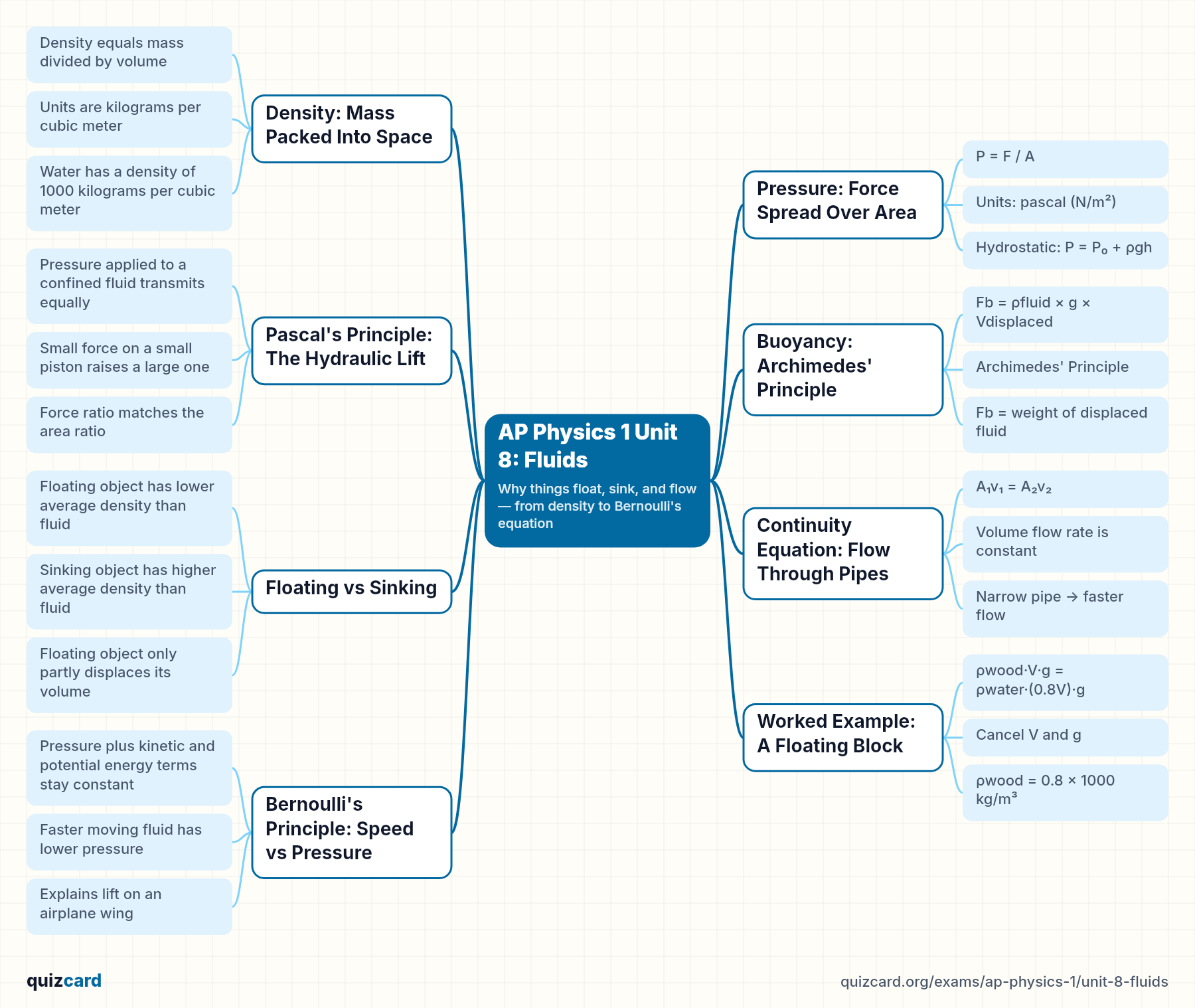
Density tells you how much mass is packed into a given volume, and you get it by dividing mass by volume. A block of wood and a block of steel the same size have very different masses because steel packs far more mass into that same space. Water's density, about one thousand kilograms per cubic meter, becomes the reference point for almost every buoyancy problem you'll see.
Key points.
- Density equals mass divided by volume
- Units are kilograms per cubic meter
- Water has a density of 1000 kilograms per cubic meter
- Same material always has the same density
Pressure: Force Spread Over Area
Pressure is just force spread over a surface, so we write pressure equals force divided by area, measured in pascals. But in a fluid at rest, pressure doesn't stay constant, it grows with depth. We write that as pressure equals atmospheric pressure plus density times gravity times depth. So a diver ten meters down feels noticeably more pressure than one at the surface, purely because of the water piled above them.
P = F / A
Units: pascal (N/m²)
Hydrostatic: P = P₀ + ρgh
Deeper fluid → greater pressure
Key points.
- Pressure equals force divided by area
- Measured in pascals, newtons per square meter
- Hydrostatic pressure increases with depth
- Deeper fluid means more pressure pushing on you
Pascal's Principle: The Hydraulic Lift
Pascal's principle says that if you squeeze a confined fluid, that added pressure spreads equally in every direction throughout the fluid. That's how a hydraulic lift works: you push down with a small force on a small piston, and because pressure is the same everywhere, a much larger piston on the other side gets pushed up with a much larger force, letting a small push lift an entire car.
Key points.
- Pressure applied to a confined fluid transmits equally
- Small force on a small piston raises a large one
- Force ratio matches the area ratio
- Used in car jacks and hydraulic brakes
Buoyancy: Archimedes' Principle
Archimedes' principle tells us that the buoyant force on an object equals the weight of the fluid it pushes out of the way. We write that as buoyant force equals fluid density times gravity times the volume submerged. Notice the object's own weight doesn't appear in that formula at all, only how much fluid it displaces. Whether something floats or sinks then comes down to comparing that buoyant force against the object's actual weight.
Fb = ρfluid × g × Vdisplaced
Archimedes' Principle
Fb = weight of displaced fluid
Net force = Fb − Fgravity
Key points.
- Buoyant force equals weight of displaced fluid
- Depends on fluid density and submerged volume
- Not on the object's own weight directly
- Net force decides whether it floats or sinks
Floating vs Sinking
A floating object has an average density lower than the fluid around it, so it only needs to push aside part of its own volume to generate enough buoyant force to balance its weight. A sinking object has a higher average density, so even displacing its entire volume isn't enough buoyant force to cancel its weight, and it keeps sinking. That's why a hollow steel ship floats but a solid steel bolt goes straight down.
Floating
- Average density less than fluid
- Buoyant force equals weight
- Only partly submerged
Sinking
- Average density greater than fluid
- Weight exceeds buoyant force
- Fully submerged, still sinks
Continuity Equation: Flow Through Pipes
For an incompressible fluid moving through a pipe, the volume flowing past any point per second has to stay the same, which gives us the continuity equation: area one times speed one equals area two times speed two. That's why putting your thumb over a garden hose, shrinking the opening's area, makes the water shoot out much faster, since the flow rate through that smaller opening still has to match what was flowing through the wider hose.
A₁v₁ = A₂v₂
Volume flow rate is constant
Narrow pipe → faster flow
Wide pipe → slower flow
Key points.
- Volume flow rate stays constant in a pipe
- Area times speed is the same everywhere
- Narrower section means faster flow
- Comes from conservation of mass for incompressible fluid
Bernoulli's Principle: Speed vs Pressure
Bernoulli's principle is really energy conservation written for a moving fluid: pressure plus one half density times speed squared plus density times gravity times height stays constant along a streamline. The practical takeaway tested again and again is that where a fluid speeds up, its pressure drops. That's the same idea behind airplane wings and behind why a shower curtain gets pulled inward when water rushes past it.
Key points.
- Pressure plus kinetic and potential energy terms stay constant
- Faster moving fluid has lower pressure
- Explains lift on an airplane wing
- Applies along a single streamline
Worked Example: A Floating Block
Here's a typical question: a block of wood floats in water with eighty percent of its volume submerged, and you're asked to find its density. Since it's floating, buoyant force equals weight, so wood density times total volume times gravity equals water density times zero point eight times that same volume times gravity. The volume and gravity cancel on both sides, leaving wood density equals zero point eight times one thousand, which gives eight hundred kilograms per cubic meter.
ρwood·V·g = ρwater·(0.8V)·g
Cancel V and g
ρwood = 0.8 × 1000 kg/m³
ρwood = 800 kg/m³
Key points.
- Block floats with 80 percent of its volume submerged
- Set buoyant force equal to weight
- Volume and gravity cancel out
- Wood density comes out to 800 kilograms per cubic meter
Remember this
The one idea to hold onto: buoyant force depends on the fluid an object displaces, not on the object's own weight. That single idea explains most fluids questions you'll meet in AP Physics 1. Try quizzing yourself on density, pressure, and Bernoulli's equation before moving on.
Practice this unit
- MCAT Physics: Fluids, Circuits, Waves and Optics Formulas quiz15 multiple-choice questions with explanations · no account needed
- AP Physics 1: Energy, Momentum and Rotation quiz15 multiple-choice questions with explanations · no account needed
- Physics: Kinematics and Newton's Laws25 flashcards · study free
- Physics: Electricity and Circuits27 flashcards · study free
- MCAT Physics: Fluids, Circuits, Waves and Optics Formulas39 flashcards · study free
- AP Physics 1: Energy, Momentum and Rotation38 flashcards · study free
Every AP Physics 1 deck and quiz: the AP Physics 1 hub.
Other AP Physics 1 unit guides
- Unit 1: KinematicsStudy guide
- Unit 2: Force and translational dynamicsStudy guide
- Unit 3: Work, energy and powerStudy guide
- Unit 4: Linear momentumGuide + video lesson
- Unit 5: Torque and rotational dynamicsStudy guide
- Unit 6: Energy and momentum of rotating systemsStudy guide
- Unit 7: OscillationsStudy guide
Try it with your own material
Upload a PDF, slides or notes and study the deck in minutes. Making your own cards is free with no limits.