Exam prep · AP Physics 1 · Unit guide
AP Physics 1 Unit 4: Linear momentum
How momentum, impulse, and collisions connect—and how to solve a classic collision problem
On the exam: Impulse, conservation of momentum, collisions. 10 to 15%.
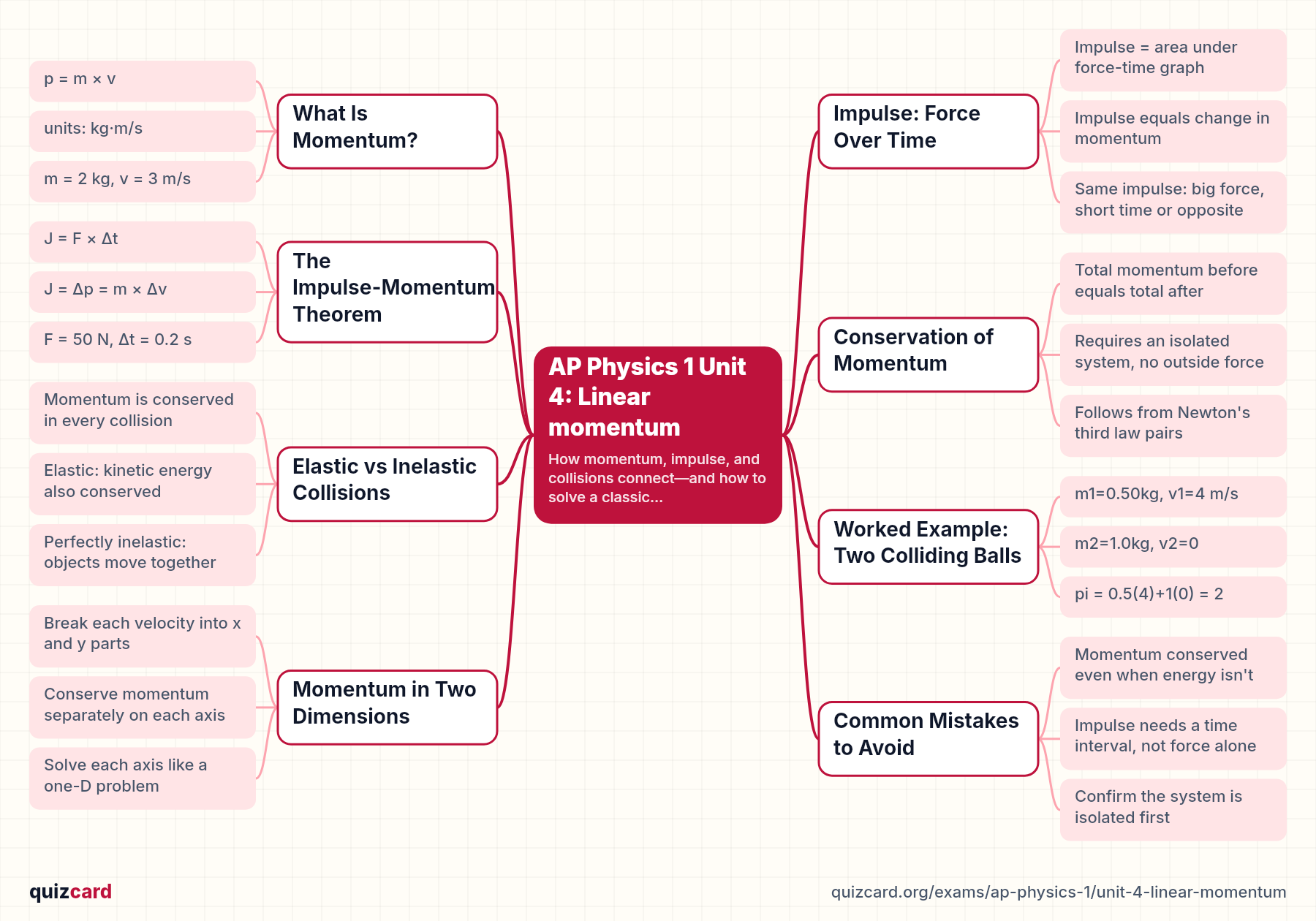
Think a bigger, heavier object always wins a crash? In AP Physics 1's unit on linear momentum, that instinct gets students the wrong sign every time. This video covers momentum, impulse, conservation, elastic versus inelastic collisions, and walks through a classic collision problem step by step.
Watch the lesson
Watch on YouTube · 30-second version
What Is Momentum?
Momentum tells you how hard it is to stop something that's moving. It's defined as mass times velocity, so it's a vector that always points the same way the object is moving. The unit is kilogram meters per second. Take a two kilogram cart rolling at three meters per second: its momentum is six kilogram meters per second, pointing in the direction it's rolling.
p = m × v
units: kg·m/s
m = 2 kg, v = 3 m/s
p = 6 kg·m/s
Key points.
- Momentum = mass times velocity
- Vector, same direction as velocity
- SI unit: kilogram meter per second
- Example: 2 kg at 3 m/s = 6 kg·m/s
Impulse: Force Over Time
Impulse is what actually changes an object's momentum, and it's the area under a force versus time graph. A huge force acting for a split second can deliver the same impulse as a gentler force acting longer. That's why airbags work: by stretching out the collision time, they cut the force your body feels while the impulse, the total change in momentum, stays exactly the same.
Key points.
- Impulse = area under force-time graph
- Impulse equals change in momentum
- Same impulse: big force, short time or opposite
- Airbags stretch the time to reduce force
The Impulse-Momentum Theorem
This theorem just rewrites Newton's second law in terms of momentum: impulse equals force times the time it acts, and that impulse equals the change in momentum, mass times the change in velocity. Say a bat hits a ball with fifty newtons of force for two tenths of a second. The impulse is ten newton seconds, so the ball's momentum changes by exactly ten kilogram meters per second in that same direction.
J = F × Δt
J = Δp = m × Δv
F = 50 N, Δt = 0.2 s
J = 10 N·s = Δp
Key points.
- Impulse equals force times time interval
- Impulse equals change in momentum
- Comes straight from Newton's second law
- Example: 50 N for 0.2 s gives 10 N·s
Conservation of Momentum
The single biggest idea in this unit is that total momentum of a system doesn't change unless something outside the system pushes on it. Inside a collision, the two objects push on each other with equal and opposite forces, by Newton's third law, so those internal forces cancel out and never change the total. That's why you can add up momentum before a crash and set it equal to momentum after, even though each object's individual momentum changes.
If no net external force acts on a system, its total momentum stays constant. Law of Conservation of Momentum
Key points.
- Total momentum before equals total after
- Requires an isolated system, no outside force
- Follows from Newton's third law pairs
- Applies separately to x and y directions
Elastic vs Inelastic Collisions
Collisions come in two flavors. In an elastic collision, kinetic energy is conserved along with momentum, like two billiard balls bouncing off each other. In an inelastic collision, kinetic energy is lost to heat and deformation, even though momentum is always conserved regardless of type. The extreme case is a perfectly inelastic collision, where the objects stick together afterward and move with one shared velocity, like two train cars coupling.
Elastic
- Kinetic energy is conserved
- Objects bounce apart
- Momentum is conserved
- Example: billiard balls
Inelastic
- Kinetic energy is not conserved
- Perfectly inelastic: objects stick together
- Momentum is still conserved
- Example: train cars coupling
Worked Example: Two Colliding Balls
Here's a typical question: a half kilogram ball moving right at four meters per second hits a one kilogram ball at rest. Afterward, the first ball bounces back at one meter per second. Momentum before is two kilogram meters per second. Momentum after is negative zero point five plus the second ball's momentum. Setting them equal and solving gives a final velocity of two point five meters per second.
m1=0.50kg, v1=4 m/s
m2=1.0kg, v2=0
pi = 0.5(4)+1(0) = 2
pf = 0.5(−1)+1(v2)
2 = −0.5 + v2
v2 = 2.5 m/s
Key points.
- Write momentum before: sum of each p
- Write momentum after with unknown velocity
- Set before equal to after
- Solve algebraically for the unknown
Momentum in Two Dimensions
Not every collision happens along a straight line. When two pucks collide at an angle, you treat the x direction and the y direction as two separate, independent conservation problems. You break every velocity into its x and y components, apply conservation of momentum on each axis separately, solve for the unknowns, and then recombine the components at the end to get the final speed and direction of each object.
Key points.
- Break each velocity into x and y parts
- Conserve momentum separately on each axis
- Solve each axis like a one-D problem
- Recombine with vector addition for final answer
Common Mistakes to Avoid
A few habits save you on this unit. Remember that momentum is conserved in every collision, even when kinetic energy isn't, so don't assume energy conservation unless you're told it's elastic. Impulse always needs a time interval, not just a force value. Before applying conservation of momentum, check that the system is actually isolated. And always define a positive direction first, because a wrong sign on velocity is the most common way to lose points.
Key points.
- Momentum conserved even when energy isn't
- Impulse needs a time interval, not force alone
- Confirm the system is isolated first
- Pick a positive direction and keep signs consistent
Remember this
The one thing to hold onto: total momentum of an isolated system never changes, whether the collision is elastic or not. For AP Physics 1, practice setting up before-and-after equations, then quiz yourself on a few collision problems.
Practice this unit
- MCAT Physics: Fluids, Circuits, Waves and Optics Formulas quiz15 multiple-choice questions with explanations · no account needed
- AP Physics 1: Energy, Momentum and Rotation quiz15 multiple-choice questions with explanations · no account needed
- Physics: Kinematics and Newton's Laws25 flashcards · study free
- Physics: Electricity and Circuits27 flashcards · study free
- MCAT Physics: Fluids, Circuits, Waves and Optics Formulas39 flashcards · study free
- AP Physics 1: Energy, Momentum and Rotation38 flashcards · study free
Every AP Physics 1 deck and quiz: the AP Physics 1 hub.
Other AP Physics 1 unit guides
- Unit 1: KinematicsStudy guide
- Unit 2: Force and translational dynamicsStudy guide
- Unit 3: Work, energy and powerStudy guide
- Unit 5: Torque and rotational dynamicsStudy guide
- Unit 6: Energy and momentum of rotating systemsStudy guide
- Unit 7: OscillationsStudy guide
- Unit 8: FluidsStudy guide
Try it with your own material
Upload a PDF, slides or notes and study the deck in minutes. Making your own cards is free with no limits.