Exam prep · AP Physics 1 · Unit guide
AP Physics 1 Unit 3: Work, energy and power
How forces transfer energy, why energy is conserved, and how fast it moves
On the exam: Work, conservation of energy, power. 18 to 23%.
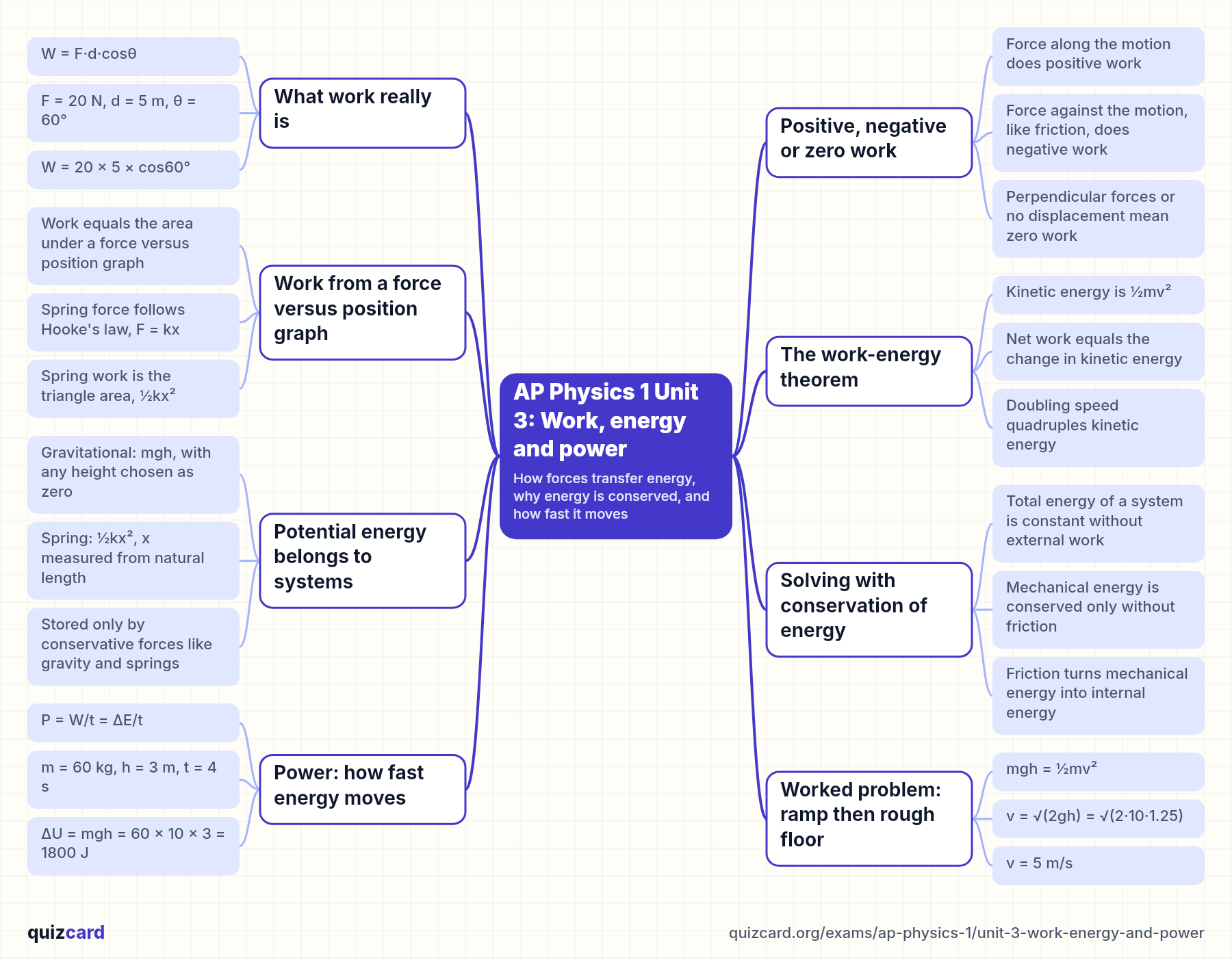
Does the normal force do work on a box sliding across the floor? Lots of physics students say yes, but it's zero. We'll cover work, kinetic and potential energy, conservation of energy and power, then solve a classic ramp problem step by step.
What work really is
Work is how a force transfers energy to an object as it moves. You find it by multiplying the force by the displacement and by the cosine of the angle between them. Say you pull a sled with twenty newtons at sixty degrees up for five meters. That's twenty times five times the cosine of sixty, which is one half, so the rope does fifty joules of work.
W = F·d·cosθ
F = 20 N, d = 5 m, θ = 60°
W = 20 × 5 × cos60°
W = 20 × 5 × 0.5 = 50 J
Key points.
- Work is energy transferred by a force over a displacement
- W = Fd cosθ, measured in joules
- Only the force component along the motion counts
Positive, negative or zero work
A force only does work if it has a component along the displacement. When it points with the motion, like your push on a cart, the work is positive and the object gains energy. When it points against the motion, like friction, the work is negative. And if the force is perpendicular, like the normal force on a level floor or tension in circular motion, it does zero work.
Force does work
- Has a component along the displacement
- Positive: pushes with the motion
- Negative: opposes motion, like friction
Force does zero work
- No displacement, like holding a box still
- Force perpendicular to the motion
- Normal force on a level floor
- Tension in uniform circular motion
Work from a force versus position graph
When a force changes as the object moves, you can't just multiply. Instead, the work equals the area under the force versus position graph. For a spring, Hooke's law says the force is k times x, so the graph is a straight line and the area is a triangle, one half k x squared. Stretch a two hundred newton per meter spring by ten centimeters, and that's one joule.
Key points.
- Work equals the area under a force versus position graph
- Spring force follows Hooke's law, F = kx
- Spring work is the triangle area, ½kx²
The work-energy theorem
This is the work energy theorem, and it ties forces to motion. Kinetic energy is one half m v squared, so doubling the speed quadruples it. Take a two kilogram cart speeding up from three to five meters per second. Its kinetic energy goes from nine joules to twenty five joules, so the net work on it, adding up every force, is sixteen joules.
The net work done on an object equals its change in kinetic energy. Work-energy theorem
Key points.
- Kinetic energy is ½mv²
- Net work equals the change in kinetic energy
- Doubling speed quadruples kinetic energy
Potential energy belongs to systems
Potential energy is stored in the arrangement of a system, not in one object alone. Gravitational potential energy belongs to the object and Earth together, m g h, and you can pick any height as zero, because only changes matter. A spring stores one half k x squared. Only conservative forces, like gravity and springs, store energy this way, since their work doesn't depend on the path. Friction can't.
Key points.
- Gravitational: mgh, with any height chosen as zero
- Spring: ½kx², x measured from natural length
- Stored only by conservative forces like gravity and springs
- Friction is nonconservative and stores no potential energy
Solving with conservation of energy
If no external force does work on your system, its total energy stays constant. Mechanical energy, kinetic plus potential, is only conserved when there's no friction or other nonconservative forces inside. With friction, some energy becomes internal energy, warming the surfaces. So pick your system, draw energy bar charts for the start and end, add any external work, and set the two sides equal.
- Choose your system and its boundary
- Draw energy bar charts for start and end
- Include external work and friction losses
- Set initial energy plus work equal to final
- Solve, then check units and sense
Power: how fast energy moves
Power is how fast energy is transferred, work divided by time, measured in watts. Say a sixty kilogram student climbs three meters of stairs in four seconds. The gain in potential energy is m g h, sixty times ten times three, or eighteen hundred joules. Divide by four seconds and you get four hundred fifty watts. For a constant force, power also equals force times velocity.
P = W/t = ΔE/t
m = 60 kg, h = 3 m, t = 4 s
ΔU = mgh = 60 × 10 × 3 = 1800 J
P = 1800/4 = 450 W
P = F·v
Key points.
- Power is work or energy change divided by time
- Measured in watts, one joule per second
- For a constant force, P = Fv
Worked problem: ramp then rough floor
A block slides from rest down a frictionless ramp one point two five meters high, onto a floor with mu of zero point two five. First, m g h equals one half m v squared, so v equals the square root of two g h, five meters per second. Friction then takes that energy, so one half m v squared equals mu m g d, and d is twenty five over five, five meters.
mgh = ½mv²
v = √(2gh) = √(2·10·1.25)
v = 5 m/s
½mv² = μmg·d
d = v²/(2μg) = 25/5 = 5 m
Key points.
- Frictionless ramp: gravitational energy becomes kinetic
- Mass cancels, so v = √(2gh) = 5 m/s
- Friction's work removes the kinetic energy
- Stopping distance d = v²/(2μg) = 5 m
Remember this
If you remember one thing, make it this: work is energy transferred, so track every joule in your system from start to finish. Now quiz yourself on these ideas and try a few ramp and spring problems on your own.
Practice this unit
- MCAT Physics: Fluids, Circuits, Waves and Optics Formulas quiz15 multiple-choice questions with explanations · no account needed
- AP Physics 1: Energy, Momentum and Rotation quiz15 multiple-choice questions with explanations · no account needed
- Physics: Kinematics and Newton's Laws25 flashcards · study free
- Physics: Electricity and Circuits27 flashcards · study free
- MCAT Physics: Fluids, Circuits, Waves and Optics Formulas39 flashcards · study free
- AP Physics 1: Energy, Momentum and Rotation38 flashcards · study free
Every AP Physics 1 deck and quiz: the AP Physics 1 hub.
Other AP Physics 1 unit guides
- Unit 1: KinematicsStudy guide
- Unit 2: Force and translational dynamicsStudy guide
- Unit 4: Linear momentumGuide + video lesson
- Unit 5: Torque and rotational dynamicsStudy guide
- Unit 6: Energy and momentum of rotating systemsStudy guide
- Unit 7: OscillationsStudy guide
- Unit 8: FluidsStudy guide
Try it with your own material
Upload a PDF, slides or notes and study the deck in minutes. Making your own cards is free with no limits.