Exam prep · AP Physics 1 · Unit guide
AP Physics 1 Unit 7: Oscillations
Learn why restoring forces create repeating motion, and how to find period and speed
On the exam: Simple harmonic motion, springs and pendulums. 5 to 8%.
Ever notice that a pendulum swings back in exactly the same time whether you push it a little or a lot? That single fact trips up a lot of students in AP Physics 1. This video walks through simple harmonic motion, the spring and pendulum period formulas, energy exchange, and a full worked problem.
What Makes Motion Simple Harmonic
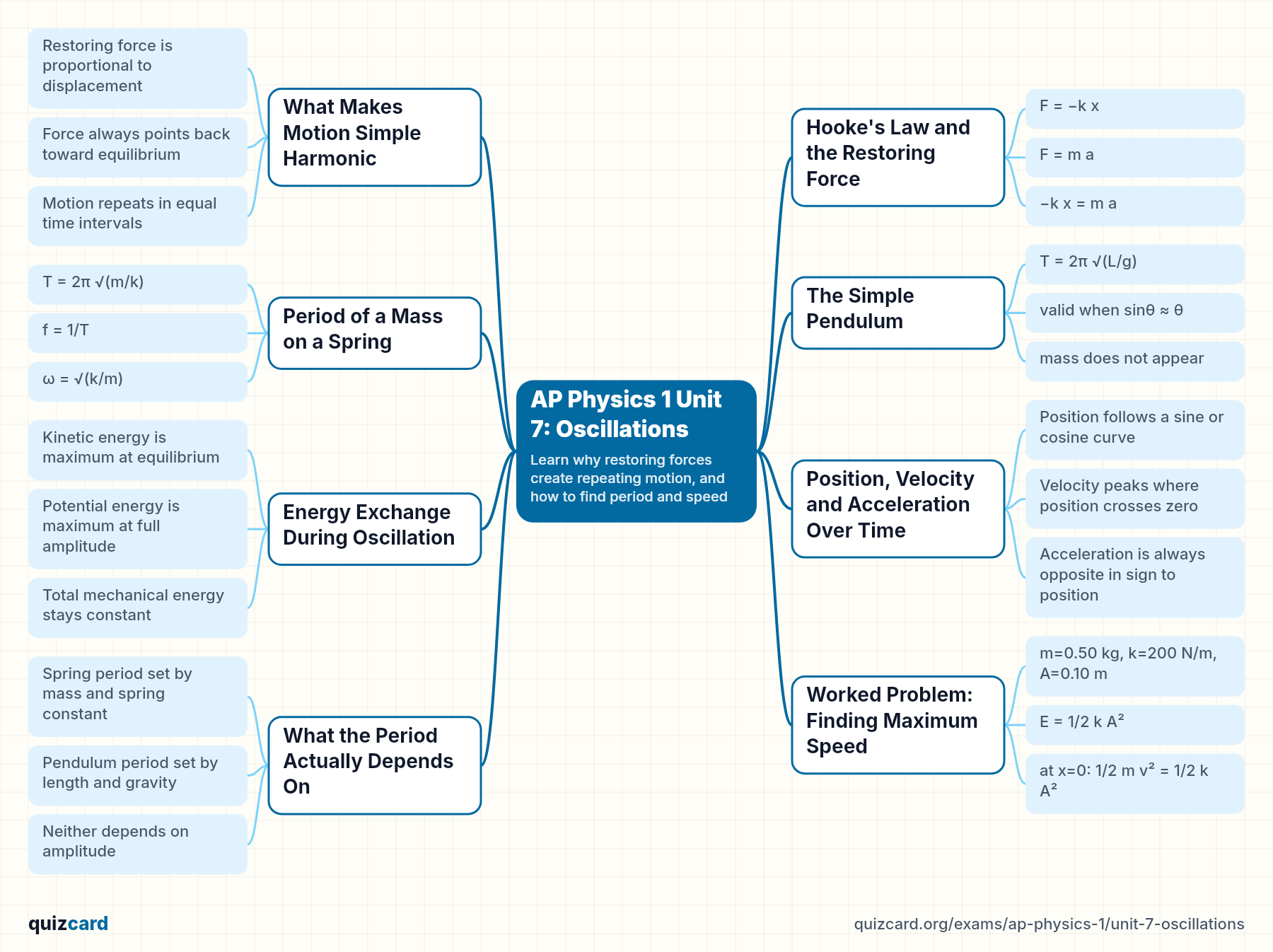
Simple harmonic motion isn't just any back and forth wiggle. It happens whenever the force pulling something back toward its resting position grows in exact proportion to how far it's been pushed away. Stretch a spring twice as far, and the pull back is twice as strong. That proportional restoring force is what guarantees the motion repeats with a steady, predictable rhythm.
Simple harmonic motion is periodic motion in which the restoring force is directly proportional to displacement and directed toward equilibrium. AP Physics 1 definition
Key points.
- Restoring force is proportional to displacement
- Force always points back toward equilibrium
- Motion repeats in equal time intervals
- Springs and pendulums are the two classic examples
Hooke's Law and the Restoring Force
For a spring, the restoring force follows Hooke's law: force equals negative k times x, where k is the spring constant and x is how far you've stretched or compressed it. Set that equal to mass times acceleration from Newton's second law, and you can solve for acceleration. You end up with acceleration equal to negative k over m times x, which is the mathematical signature of simple harmonic motion.
F = −k x
F = m a
−k x = m a
a = −(k/m) x
Key points.
- Spring force equals negative k times displacement
- Negative sign shows force opposes displacement
- Combine with Newton's second law
- Acceleration is also proportional to displacement
Period of a Mass on a Spring
For a mass oscillating on a spring, the period, meaning the time for one full cycle, equals two pi times the square root of mass over spring constant. Notice what's missing: amplitude isn't in that formula at all. A bigger mass makes the period longer because there's more inertia to drag around, while a stiffer spring, meaning a larger k, makes the period shorter because the restoring force is stronger.
T = 2π √(m/k)
f = 1/T
ω = √(k/m)
Key points.
- Period depends on mass and spring constant
- Larger mass means longer period
- Stiffer spring means shorter period
- Frequency is just one over the period
The Simple Pendulum
A simple pendulum's period equals two pi times the square root of length over gravitational acceleration g. This only holds for small swing angles, typically under about fifteen degrees, because that's where sine of theta is approximately equal to theta itself, which keeps the restoring force proportional to displacement. Notice mass doesn't appear anywhere in this formula, so a heavy bob and a light bob with the same length swing at exactly the same rate.
T = 2π √(L/g)
valid when sinθ ≈ θ
mass does not appear
Key points.
- Period depends on length and gravity only
- Formula valid for small swing angles
- Mass of the bob does not matter
- Small angle lets sine theta approximate theta
Energy Exchange During Oscillation
As the mass or pendulum swings, energy keeps trading between kinetic and potential, but the total stays fixed if there's no friction. Right at equilibrium, speed is at its maximum, so kinetic energy peaks while spring or gravitational potential energy is zero. Out at the amplitude, the object momentarily stops, so potential energy peaks and kinetic energy is zero. The total mechanical energy equals one half k times amplitude squared.
Key points.
- Kinetic energy is maximum at equilibrium
- Potential energy is maximum at full amplitude
- Total mechanical energy stays constant
- Total energy equals one half k times A squared
Position, Velocity and Acceleration Over Time
If you graph position, velocity and acceleration against time for an oscillator, you get three sine-shaped curves that are shifted relative to each other. Velocity is largest exactly where position crosses zero, and it's zero at the amplitude where the object turns around. Acceleration always points opposite to position, so it's largest in magnitude right when displacement is largest, and zero at equilibrium.
Key points.
- Position follows a sine or cosine curve
- Velocity peaks where position crosses zero
- Acceleration is always opposite in sign to position
- All three graphs share the same period
What the Period Actually Depends On
A question that trips students up constantly: does a bigger push change how long one swing takes? For both the spring and the pendulum, the answer is no. Amplitude changes how far or fast something moves, but not how long a cycle takes. For a spring, only mass and spring constant set the period. For a pendulum, only length and gravitational acceleration matter, and the bob's mass has no effect at all.
Period depends on
- Mass and spring constant (spring)
- Length and gravity (pendulum)
Period does NOT depend on
- Amplitude
- Mass of the pendulum bob
- Initial displacement
Worked Problem: Finding Maximum Speed
Here's a typical question: a zero point five kilogram mass sits on a spring with spring constant two hundred newtons per meter, oscillating with amplitude zero point one meters. Find its maximum speed. Start from total energy, one half k A squared. At equilibrium, all of that energy is kinetic, so one half m v squared equals one half k A squared. Solving for v gives A times the square root of k over m, which works out to point one times the square root of four hundred, giving two meters per second.
m=0.50 kg, k=200 N/m, A=0.10 m
E = 1/2 k A²
at x=0: 1/2 m v² = 1/2 k A²
v = A × √(k/m)
v = 0.10 × √(200/0.50)
v = 0.10 × 20 = 2.0 m/s
Key points.
- Given mass, spring constant and amplitude
- Total energy equals one half k A squared
- At equilibrium all energy is kinetic
- Solve for maximum speed
Remember this
The one thing to remember: period depends on the physical setup, mass and spring constant, or length and gravity, never on amplitude. Now that you've seen how AP Physics 1 tests this unit, try quizzing yourself on the formulas and a few energy and graph questions before moving on.
Practice this unit
- MCAT Physics: Fluids, Circuits, Waves and Optics Formulas quiz15 multiple-choice questions with explanations · no account needed
- AP Physics 1: Energy, Momentum and Rotation quiz15 multiple-choice questions with explanations · no account needed
- Physics: Kinematics and Newton's Laws25 flashcards · study free
- Physics: Electricity and Circuits27 flashcards · study free
- MCAT Physics: Fluids, Circuits, Waves and Optics Formulas39 flashcards · study free
- AP Physics 1: Energy, Momentum and Rotation38 flashcards · study free
Every AP Physics 1 deck and quiz: the AP Physics 1 hub.
Other AP Physics 1 unit guides
- Unit 1: KinematicsStudy guide
- Unit 2: Force and translational dynamicsStudy guide
- Unit 3: Work, energy and powerStudy guide
- Unit 4: Linear momentumGuide + video lesson
- Unit 5: Torque and rotational dynamicsStudy guide
- Unit 6: Energy and momentum of rotating systemsStudy guide
- Unit 8: FluidsStudy guide
Try it with your own material
Upload a PDF, slides or notes and study the deck in minutes. Making your own cards is free with no limits.