Exam prep · AP Calculus AB · Unit guide
AP Calculus AB Unit 5: Analytical applications of differentiation
Use derivatives to find extrema, test concavity, and solve optimization problems
On the exam: Mean Value Theorem, extrema, concavity, optimization. 15 to 18%.
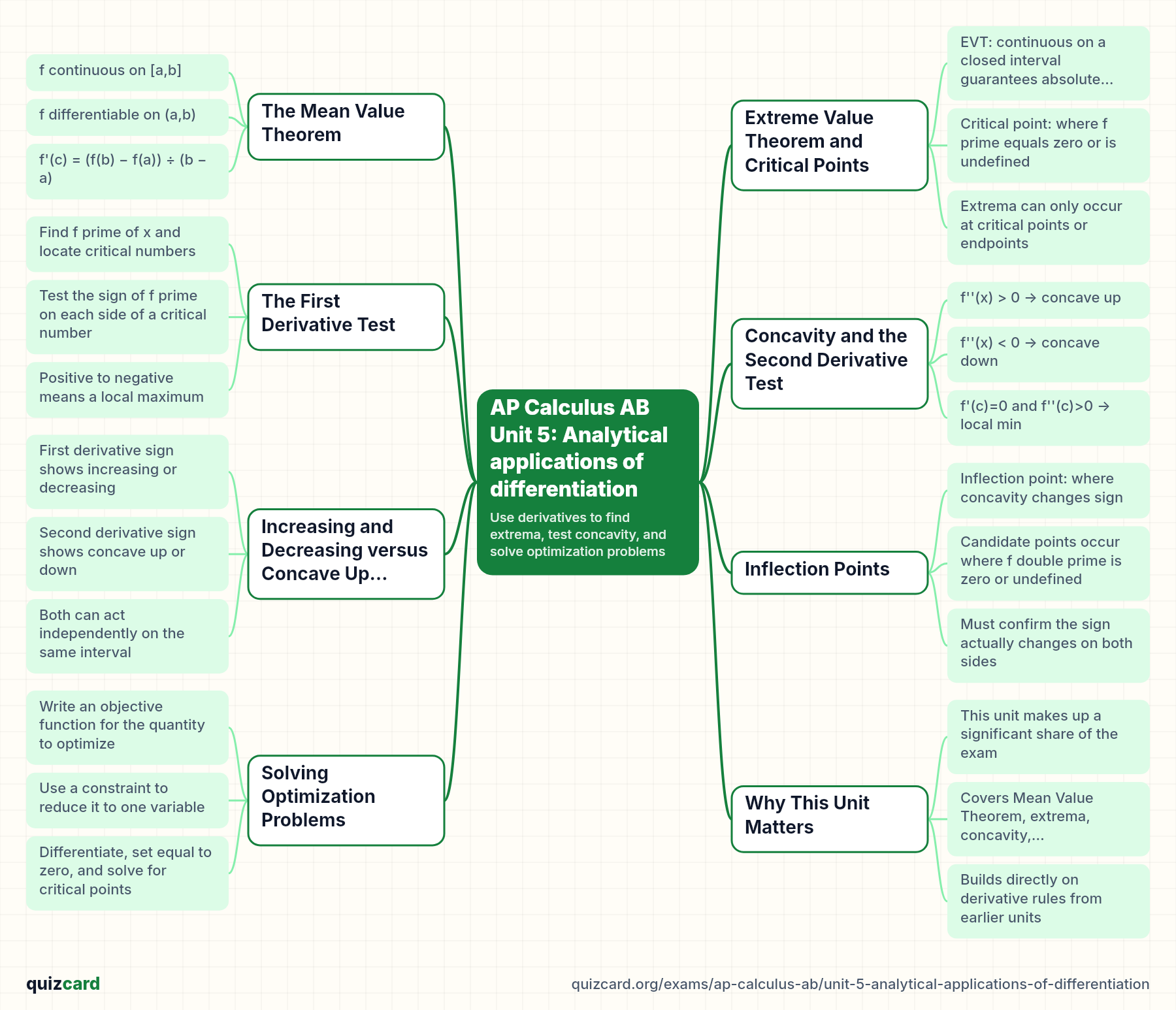
In this AP Calculus AB unit, we turn derivatives into tools for understanding a function's shape and behavior. You'll learn the Mean Value Theorem, how to locate maximums and minimums, how concavity reveals a curve's bending, and how to solve real optimization problems step by step.
Watch the lesson
Watch on YouTube · 30-second version
The Mean Value Theorem
The Mean Value Theorem says that if a function is continuous on a closed interval and differentiable on the open interval, then somewhere inside, the instantaneous rate of change equals the average rate of change over the whole interval. Take f of x equals x squared on the interval from zero to two. The average rate is four minus zero over two, which is two. Setting the derivative, two x, equal to two gives c equals one.
f continuous on [a,b]
f differentiable on (a,b)
f'(c) = (f(b) − f(a)) ÷ (b − a)
Example: f(x) = x²
f'(c) = 2c = 2 → c = 1
Key points.
- Requires continuity on [a,b] and differentiability on (a,b)
- Guarantees some c where instantaneous rate equals average rate
- Example: f(x)=x squared on [0,2] gives c equals 1
- Geometrically, a tangent line parallel to the secant line
Extreme Value Theorem and Critical Points
The Extreme Value Theorem tells us that any function continuous on a closed interval must reach an absolute maximum and an absolute minimum somewhere on that interval. To find them, we look at critical points, places where the derivative is zero or does not exist, along with the two endpoints. We then plug every one of those candidate inputs back into the original function and compare the outputs to see which gives the largest and smallest values.
Key points.
- EVT: continuous on a closed interval guarantees absolute max and min
- Critical point: where f prime equals zero or is undefined
- Extrema can only occur at critical points or endpoints
- Closed interval method: evaluate f at every candidate point
The First Derivative Test
Once we know the critical numbers, the First Derivative Test tells us whether each one is a local max, a local min, or neither, just by watching how the sign of the derivative changes. Consider f of x equals x cubed minus three x. Its derivative is three x squared minus three, which is zero at x equals negative one and x equals one. Checking signs around those points shows a local maximum at negative one and a local minimum at one.
- Find f'(x) and solve f'(x)=0 or undefined
- Identify the critical numbers
- Check the sign of f' on intervals around each one
- Sign change + to − gives local max, − to + gives local min
Concavity and the Second Derivative Test
The second derivative tells us about concavity. When f double prime is positive, the curve bends upward like a cup; when it is negative, the curve bends downward like a frown. This gives us the Second Derivative Test: if f prime of c is zero and f double prime of c is positive, c is a local minimum; if f double prime of c is negative, c is a local maximum. For f of x equals x cubed minus three x, f double prime is six x, confirming a local max at negative one and a local min at one.
f''(x) > 0 → concave up
f''(x) < 0 → concave down
f'(c)=0 and f''(c)>0 → local min
f'(c)=0 and f''(c)<0 → local max
Key points.
- Second derivative positive means the curve is concave up
- Second derivative negative means the curve is concave down
- At a critical point, positive f double prime signals a local min
- At a critical point, negative f double prime signals a local max
Increasing and Decreasing versus Concave Up and Down
It helps to keep the first and second derivatives straight, because they answer different questions. The first derivative tells you whether the function itself is going up or down. The second derivative tells you whether that rate of change is speeding up or slowing down, which is what we call concavity. A function can be increasing while concave down, like a curve rising but leveling off, or increasing while concave up, rising faster and faster.
First derivative f'
- f' > 0: function increasing
- f' < 0: function decreasing
- f' = 0: possible extremum
Second derivative f''
- f'' > 0: concave up, f' increasing
- f'' < 0: concave down, f' decreasing
- f'' = 0: possible inflection point
Inflection Points
An inflection point is a place where a curve switches from concave up to concave down, or the reverse. To find candidates, we solve for where the second derivative equals zero or fails to exist, but that alone is not enough; we must check that concavity truly changes sign on either side. For f of x equals x cubed, the second derivative is six x, which is zero at x equals zero, and the concavity does flip there, so zero is a genuine inflection point.
Key points.
- Inflection point: where concavity changes sign
- Candidate points occur where f double prime is zero or undefined
- Must confirm the sign actually changes on both sides
- Example: f(x) equals x cubed has an inflection point at zero
Solving Optimization Problems
Optimization problems ask us to maximize or minimize some quantity, like area, volume, or cost. The method is always the same: write an equation for the quantity you care about, use any given constraint to rewrite it in terms of a single variable, then take the derivative and set it to zero to find critical points. For example, maximizing the area of a rectangle with a fixed perimeter of twenty leads to a square, since the derivative of the area function is zero exactly when the sides are equal.
- Write the objective function for the quantity to optimize
- Apply the constraint to reduce to one variable
- Differentiate and solve f'(x)=0 for critical points
- Confirm with the first or second derivative test
- Check endpoints if the domain is a closed interval
Why This Unit Matters
This unit on analytical applications of differentiation carries real weight, accounting for roughly fifteen to eighteen percent of the entire exam. That makes it one of the most heavily tested topics in the whole course, covering the Mean Value Theorem, locating extrema, analyzing concavity, and solving optimization problems. Mastering these ideas also prepares you for later units on curve sketching, since every tool here describes some feature of a function's graph.
15–18% share of the AP Calculus AB exam devoted to this unit
Key points.
- This unit makes up a significant share of the exam
- Covers Mean Value Theorem, extrema, concavity, and optimization
- Builds directly on derivative rules from earlier units
- Sets up curve sketching and real-world modeling questions
Remember this
The key idea to remember: derivatives describe shape, the first finds where a function rises or falls, the second reveals its bend, and together they let you optimize anything. As you prepare for AP Calculus AB, try quizzing yourself on these definitions and worked examples to lock them in.
Practice this unit
- Algebra and Geometry: Essential Formulas quiz18 multiple-choice questions with explanations · no account needed
- AP Calculus AB: Limits, Continuity and Derivative Rules quiz15 multiple-choice questions with explanations · no account needed
- Calculus: Derivatives and Integrals30 flashcards · study free
- Algebra and Geometry: Essential Formulas30 flashcards · study free
- AP Calculus AB: Limits, Continuity and Derivative Rules34 flashcards · study free
Every AP Calculus AB deck and quiz: the AP Calculus AB hub.
Other AP Calculus AB unit guides
- Unit 1: Limits and continuityStudy guide
- Unit 2: Differentiation: definition and fundamental propertiesGuide + video lesson
- Unit 3: Differentiation: composite, implicit and inverse functionsStudy guide
- Unit 4: Contextual applications of differentiationStudy guide
- Unit 6: Integration and accumulation of changeGuide + video lesson
- Unit 7: Differential equationsGuide + video lesson
- Unit 8: Applications of integrationStudy guide
Try it with your own material
Upload a PDF, slides or notes and study the deck in minutes. Making your own cards is free with no limits.