Exam prep · AP Calculus AB · Unit guide
AP Calculus AB Unit 3: Differentiation: composite, implicit and inverse functions
How to differentiate layered functions, hidden y's and inverses, with a full worked problem
On the exam: 9 to 13%.
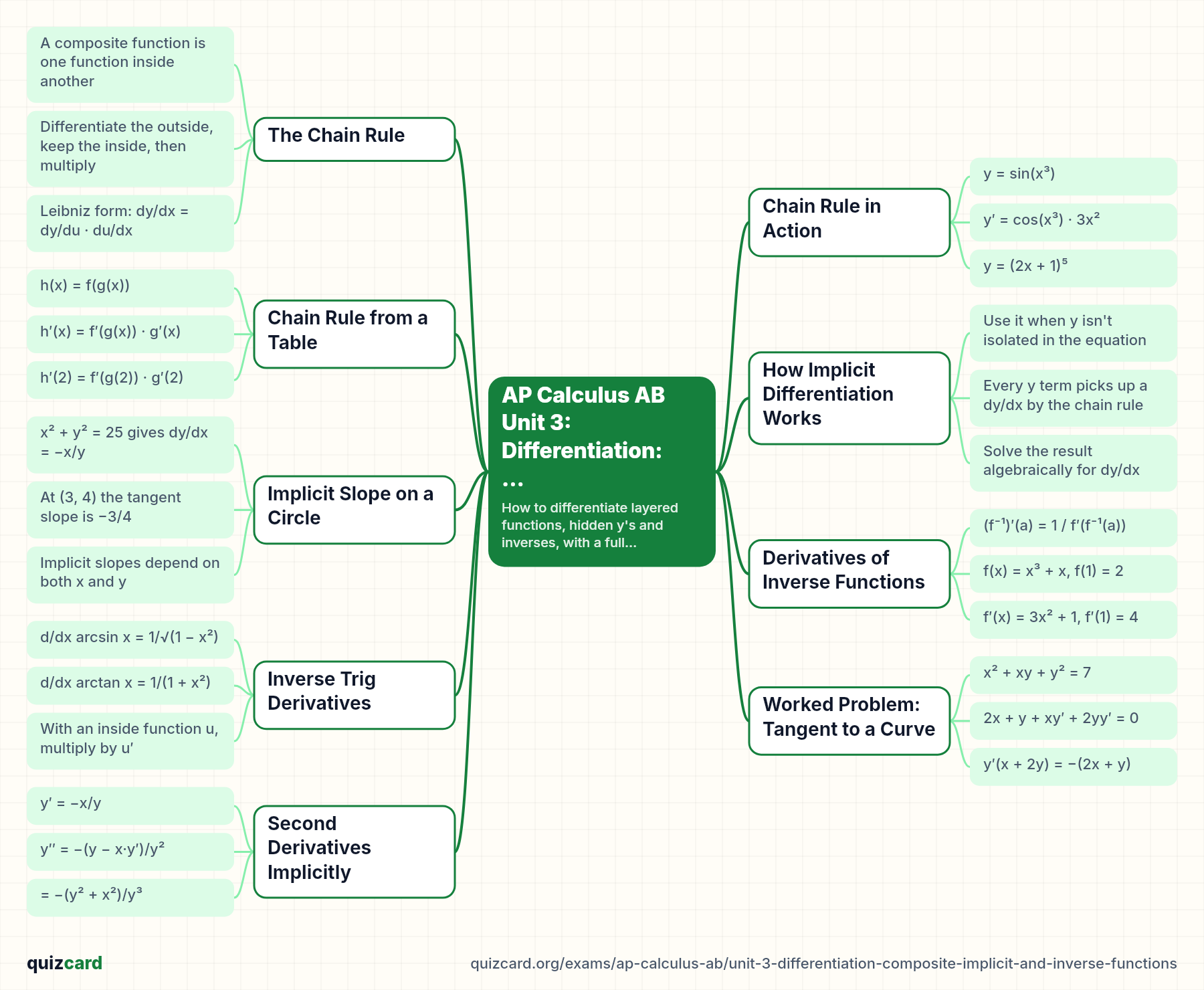
What's the one step almost everyone forgets when differentiating sine of x cubed? It's the derivative of the inside. In this calculus unit, we'll cover the chain rule, implicit differentiation, inverse functions and inverse trig, then work a typical free-response problem together.
The Chain Rule
A composite function is simply one function sitting inside another, like sine of x cubed. The chain rule tells you to differentiate the outside function while leaving the inside alone, and then multiply by the derivative of the inside. In Leibniz notation, that's dy over du times du over dx. Think of it as peeling layers, where every layer you peel adds one more factor.
If y = f(g(x)), then dy/dx = f′(g(x)) · g′(x) The chain rule
Key points.
- A composite function is one function inside another
- Differentiate the outside, keep the inside, then multiply
- Leibniz form: dy/dx = dy/du · du/dx
Chain Rule in Action
Let's start with y equals sine of x cubed. The outside is sine, so its derivative is cosine of x cubed, and then we multiply by the derivative of the inside, which is three x squared. Next, take y equals two x plus one, all to the fifth. Bring down the five and keep the inside, giving five times two x plus one to the fourth, times two, which is ten times two x plus one to the fourth.
y = sin(x³)
y′ = cos(x³) · 3x²
y = (2x + 1)⁵
y′ = 5(2x + 1)⁴ · 2 = 10(2x+1)⁴
Key points.
- Derivative of sin(x³) is cos(x³) times 3x²
- Derivative of (2x + 1)⁵ is 10(2x + 1)⁴
- Never forget the inner derivative
Chain Rule from a Table
A very common question gives you a table instead of formulas. Say h of x equals f of g of x. By the chain rule, h prime of x is f prime of g of x times g prime of x. To find h prime of two, you need f prime of g of two times g prime of two. If g of two is three and g prime of two is four, that's f prime of three times four. With f prime of three equal to negative two, the answer is negative eight.
h(x) = f(g(x))
h′(x) = f′(g(x)) · g′(x)
h′(2) = f′(g(2)) · g′(2)
= f′(3) · 4
= (−2)(4) = −8
Key points.
- Tests often give values of f, g and their derivatives
- Evaluate the inside first, then plug into f′
- Example: h′(2) = f′(3) · g′(2) = −8
How Implicit Differentiation Works
Some curves, like a circle, can't be written neatly as y equals something. Implicit differentiation handles that. You differentiate both sides with respect to x, treating y as a function of x. That means every time you differentiate a y term, the chain rule attaches a dy over dx. Terms like x times y need the product rule. Then you gather the dy over dx terms, factor, and divide.
- Differentiate both sides with respect to x
- Attach dy/dx to every y term (chain rule)
- Use the product rule on terms like xy
- Collect the dy/dx terms on one side
- Factor out dy/dx and divide
Implicit Slope on a Circle
Take the circle x squared plus y squared equals twenty five. Differentiating gives two x plus two y times dy over dx equals zero, so dy over dx equals negative x over y. At the point three, four, the slope of the tangent line is negative three fourths. Notice the slope depends on both coordinates, which is normal for implicit derivatives, and the tangent is perpendicular to the radius.
Key points.
- x² + y² = 25 gives dy/dx = −x/y
- At (3, 4) the tangent slope is −3/4
- Implicit slopes depend on both x and y
Derivatives of Inverse Functions
The derivative of an inverse at a equals one over f prime of f inverse of a. In words, the inverse's slope is the reciprocal of the original slope at the matching point. Suppose f of x is x cubed plus x. Since f of one equals two, f inverse of two is one. Next, f prime of x is three x squared plus one, so f prime of one is four. That makes the inverse's derivative at two equal to one fourth.
(f⁻¹)′(a) = 1 / f′(f⁻¹(a))
f(x) = x³ + x,  f(1) = 2
f′(x) = 3x² + 1,  f′(1) = 4
(f⁻¹)′(2) = 1/4
Key points.
- Inverse slope is the reciprocal of the original slope
- Use the matching point: f(1) = 2 means f⁻¹(2) = 1
- Example: (f⁻¹)′(2) = 1/f′(1) = 1/4
Inverse Trig Derivatives
Two inverse trig derivatives come up again and again. The derivative of arcsine of x is one over the square root of one minus x squared, and it only makes sense for x between negative one and one. The derivative of arctangent of x is one over one plus x squared, defined for every real x. If there's an inside function u, the chain rule puts u prime in the numerator.
arcsin x
- Derivative: 1/√(1 − x²)
- Domain: −1 ≤ x ≤ 1
- With chain rule: u′/√(1 − u²)
arctan x
- Derivative: 1/(1 + x²)
- Defined for all real x
- With chain rule: u′/(1 + u²)
Worked Problem: Tangent to a Curve
Here's a typical free-response question. For x squared plus x y plus y squared equals seven, find dy over dx, then the tangent line at one, two. Differentiating gives two x plus y plus x y prime plus two y y prime equals zero. Factor out y prime to get y prime times x plus two y equals negative two x plus y. Dividing, y prime is negative two x plus y over x plus two y. At one, two, that's negative four fifths, so the tangent is y minus two equals negative four fifths times x minus one.
x² + xy + y² = 7
2x + y + xy′ + 2yy′ = 0
y′(x + 2y) = −(2x + y)
y′ = −(2x + y)/(x + 2y)
At (1, 2): y′ = −4/5
y − 2 = −4/5 (x − 1)
Key points.
- Curve: x² + xy + y² = 7, point (1, 2)
- (a) dy/dx = −(2x + y)/(x + 2y)
- (b) Tangent line: y − 2 = −4/5 (x − 1)
Second Derivatives Implicitly
Higher order derivatives are also fair game. Back on the circle, y prime is negative x over y. Using the quotient rule, y double prime is negative y minus x times y prime, all over y squared. Substituting y prime equals negative x over y simplifies this to negative y squared plus x squared over y cubed. Since x squared plus y squared is twenty five, that's negative twenty five over y cubed, or negative twenty five over sixty four at three, four.
y′ = −x/y
y″ = −(y − x·y′)/y²
= −(y² + x²)/y³
= −25/y³
At (3, 4): y″ = −25/64
Key points.
- Differentiate dy/dx again using the quotient rule
- Substitute dy/dx back in to simplify
- Circle example: y″ = −25/y³, so −25/64 at (3, 4)
Remember this
If you remember one thing, make it this: every inside function and every y term brings its own derivative along as a factor. Now quiz yourself on these problems to see what sticks.
Practice this unit
- Algebra and Geometry: Essential Formulas quiz18 multiple-choice questions with explanations · no account needed
- AP Calculus AB: Limits, Continuity and Derivative Rules quiz15 multiple-choice questions with explanations · no account needed
- Calculus: Derivatives and Integrals30 flashcards · study free
- Algebra and Geometry: Essential Formulas30 flashcards · study free
- AP Calculus AB: Limits, Continuity and Derivative Rules34 flashcards · study free
Every AP Calculus AB deck and quiz: the AP Calculus AB hub.
Other AP Calculus AB unit guides
- Unit 1: Limits and continuityStudy guide
- Unit 2: Differentiation: definition and fundamental propertiesGuide + video lesson
- Unit 4: Contextual applications of differentiationStudy guide
- Unit 5: Analytical applications of differentiationGuide + video lesson
- Unit 6: Integration and accumulation of changeGuide + video lesson
- Unit 7: Differential equationsGuide + video lesson
- Unit 8: Applications of integrationStudy guide
Try it with your own material
Upload a PDF, slides or notes and study the deck in minutes. Making your own cards is free with no limits.