Exam prep · AP Calculus AB · Unit guide
AP Calculus AB Unit 2: Differentiation: definition and fundamental properties
From the limit of secant slopes to the product rule and tangent lines
On the exam: 10 to 12%.
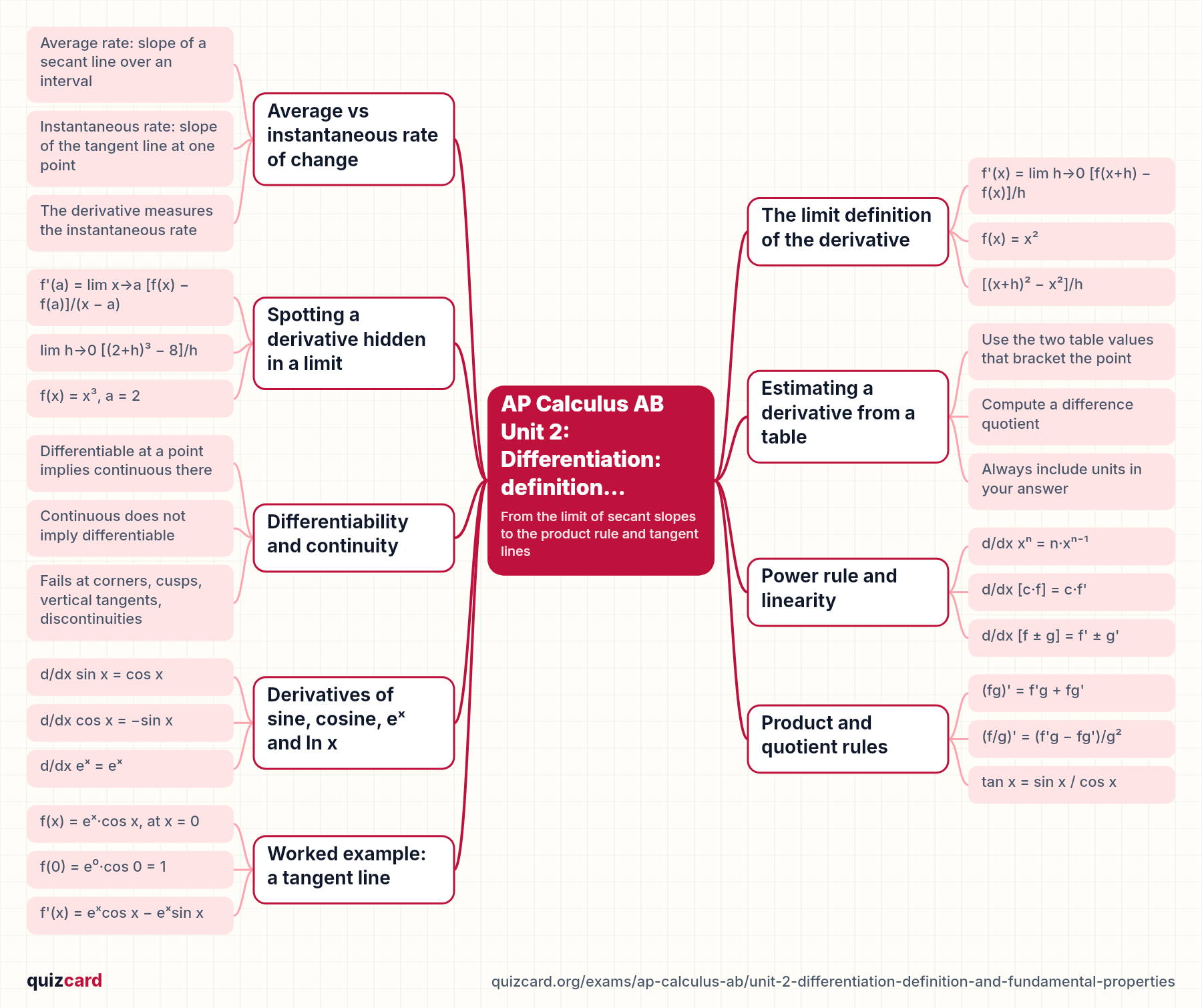
Quick question: if a function is continuous at a point, must it have a derivative there? Most students say yes, and that's wrong. For your calculus course, we'll build the derivative from its limit definition, learn the core rules, and work a full tangent line question.
Watch the lesson
Watch on YouTube · 30-second version
Average vs instantaneous rate of change
Start with the average rate of change. Over an interval from a to b, it's f of b minus f of a, divided by b minus a, which is the slope of the secant line through two points. The instantaneous rate of change is what happens at a single point, when you shrink that interval to nothing. That's the slope of the tangent line, which is what the derivative measures.
Average rate of change
- Over an interval [a, b]
- [f(b) − f(a)]/(b − a)
- Slope of a secant line
- Needs two points
Instantaneous rate of change
- At a single point x = a
- f'(a), a limit of secant slopes
- Slope of the tangent line
- Interval shrinks to zero
The limit definition of the derivative
The derivative is the limit of those secant slopes. You write f prime of x equals the limit, as h goes to zero, of f of x plus h minus f of x, all over h. For x squared, the quotient is x plus h, squared, minus x squared, over h. The numerator simplifies to two x h plus h squared, so dividing by h leaves two x plus h. Let h go to zero, and f prime of x is two x.
f'(x) = lim h→0 [f(x+h) − f(x)]/h
f(x) = x²
[(x+h)² − x²]/h
= (2xh + h²)/h = 2x + h
f'(x) = 2x
Key points.
- f'(x) is the limit of the difference quotient as h → 0
- Expand, cancel h, then let h go to zero
- For f(x) = x², f'(x) = 2x
Spotting a derivative hidden in a limit
Many questions hide a derivative inside a limit. The alternate form says f prime of a is the limit as x approaches a of f of x minus f of a, over x minus a. Take the limit as h goes to zero of two plus h, cubed, minus eight, over h. That's the definition with f of x equals x cubed and a equals two. Since f prime is three x squared, the limit is twelve.
f'(a) = lim x→a [f(x) − f(a)]/(x − a)
lim h→0 [(2+h)³ − 8]/h
f(x) = x³,  a = 2
f'(x) = 3x²
f'(2) = 3(2)² = 12
Key points.
- Alternate form: f'(a) = lim x→a [f(x) − f(a)]/(x − a)
- Match the limit to a function f and a point a
- Then use derivative rules instead of algebra
Estimating a derivative from a table
When you only have a table of values, you estimate the derivative with a difference quotient. Say f of two is ten and f of five is nineteen, and you want f prime at three. Use the two values that bracket three. The outputs change by nine while the inputs change by three, so f prime of three is approximately three. Always give the units, like meters per second, because that's part of the answer.
- Find the table values around x = 3
- Subtract outputs: 19 − 10 = 9
- Divide by the input gap: 9 ÷ 3 = 3
- State f'(3) ≈ 3, with units
Differentiability and continuity
Here's the trap from the start. If f is differentiable at a point, it must be continuous there. The reverse is false. The absolute value of x is continuous at zero, but it has a sharp corner, and the slopes from the left and right, negative one and one, don't agree. A derivative also fails to exist at a cusp, at a vertical tangent, and at any discontinuity like a jump.
Key points.
- Differentiable at a point implies continuous there
- Continuous does not imply differentiable
- Fails at corners, cusps, vertical tangents, discontinuities
Power rule and linearity
Now the shortcuts. The power rule says the derivative of x to the n is n times x to the n minus one. Constants factor out, and you can differentiate a sum term by term. So for three x to the fourth, minus five root x, plus seven, the derivative is twelve x cubed, minus five over two root x. The seven disappears, since the derivative of a constant is zero.
d/dx xⁿ = n·xⁿ⁻¹
d/dx [c·f] = c·f'
d/dx [f ± g] = f' ± g'
y = 3x⁴ − 5√x + 7
y' = 12x³ − 5/(2√x)
Key points.
- Power rule: bring the exponent down, subtract one
- Constants factor out; sums differentiate term by term
- The derivative of a constant is zero
Derivatives of sine, cosine, eˣ and ln x
A few functions have derivatives you simply memorize. The derivative of sine x is cosine x, and the derivative of cosine x is negative sine x, and that minus sign is a classic slip. The exponential e to the x is its own derivative, which makes it special. Finally, the derivative of the natural log of x is one over x, valid for positive x.
Key points.
- d/dx sin x = cos x
- d/dx cos x = −sin x
- d/dx eˣ = eˣ
- d/dx ln x = 1/x, for x > 0
Product and quotient rules
When functions are multiplied, the derivative is not the product of derivatives. The product rule gives f prime g plus f g prime. For a quotient, it's f prime g minus f g prime, all over g squared, and the order matters. Write tangent as sine over cosine, apply the quotient rule, and you get cosine squared plus sine squared, over cosine squared. That's one over cosine squared, or secant squared x.
(fg)' = f'g + fg'
(f/g)' = (f'g − fg')/g²
tan x = sin x / cos x
(cos²x + sin²x)/cos²x
= 1/cos²x = sec²x
Key points.
- Product rule: f'g + fg', not f'·g'
- Quotient rule: (f'g − fg')/g², order matters
- Gives d/dx tan x = sec²x, d/dx sec x = sec x tan x
Worked example: a tangent line
Here's a typical question: find the tangent line to e to the x times cosine x at x equals zero. First, f of zero is one times one, which is one. The product rule gives e to the x cosine x, minus e to the x sine x, so f prime of zero is one. The line is y minus one equals x, which is y equals x plus one, so f of point one is about one point one.
f(x) = eˣ·cos x,  at x = 0
f(0) = e⁰·cos 0 = 1
f'(x) = eˣcos x − eˣsin x
f'(0) = 1 − 0 = 1
y − 1 = 1(x − 0)
y = x + 1,  f(0.1) ≈ 1.1
Key points.
- Find the point: f(0) = 1
- Find the slope with the product rule: f'(0) = 1
- Tangent line y = x + 1 gives f(0.1) ≈ 1.1
Remember this
If you remember one thing, make it this: a derivative is a limit of slopes, and differentiable means continuous, never the other way around. Now quiz yourself on the definition, the rules, and a tangent line problem.
Practice this unit
- Algebra and Geometry: Essential Formulas quiz18 multiple-choice questions with explanations · no account needed
- AP Calculus AB: Limits, Continuity and Derivative Rules quiz15 multiple-choice questions with explanations · no account needed
- Calculus: Derivatives and Integrals30 flashcards · study free
- Algebra and Geometry: Essential Formulas30 flashcards · study free
- AP Calculus AB: Limits, Continuity and Derivative Rules34 flashcards · study free
Every AP Calculus AB deck and quiz: the AP Calculus AB hub.
Other AP Calculus AB unit guides
- Unit 1: Limits and continuityStudy guide
- Unit 3: Differentiation: composite, implicit and inverse functionsStudy guide
- Unit 4: Contextual applications of differentiationStudy guide
- Unit 5: Analytical applications of differentiationGuide + video lesson
- Unit 6: Integration and accumulation of changeGuide + video lesson
- Unit 7: Differential equationsGuide + video lesson
- Unit 8: Applications of integrationStudy guide
Try it with your own material
Upload a PDF, slides or notes and study the deck in minutes. Making your own cards is free with no limits.