ACT: Reading
Learn to read ACT passages the way the test expects and answer with evidence
On the exam: Passages from literature, social science, humanities and natural science; main idea, detail, inference and vocabulary in context.
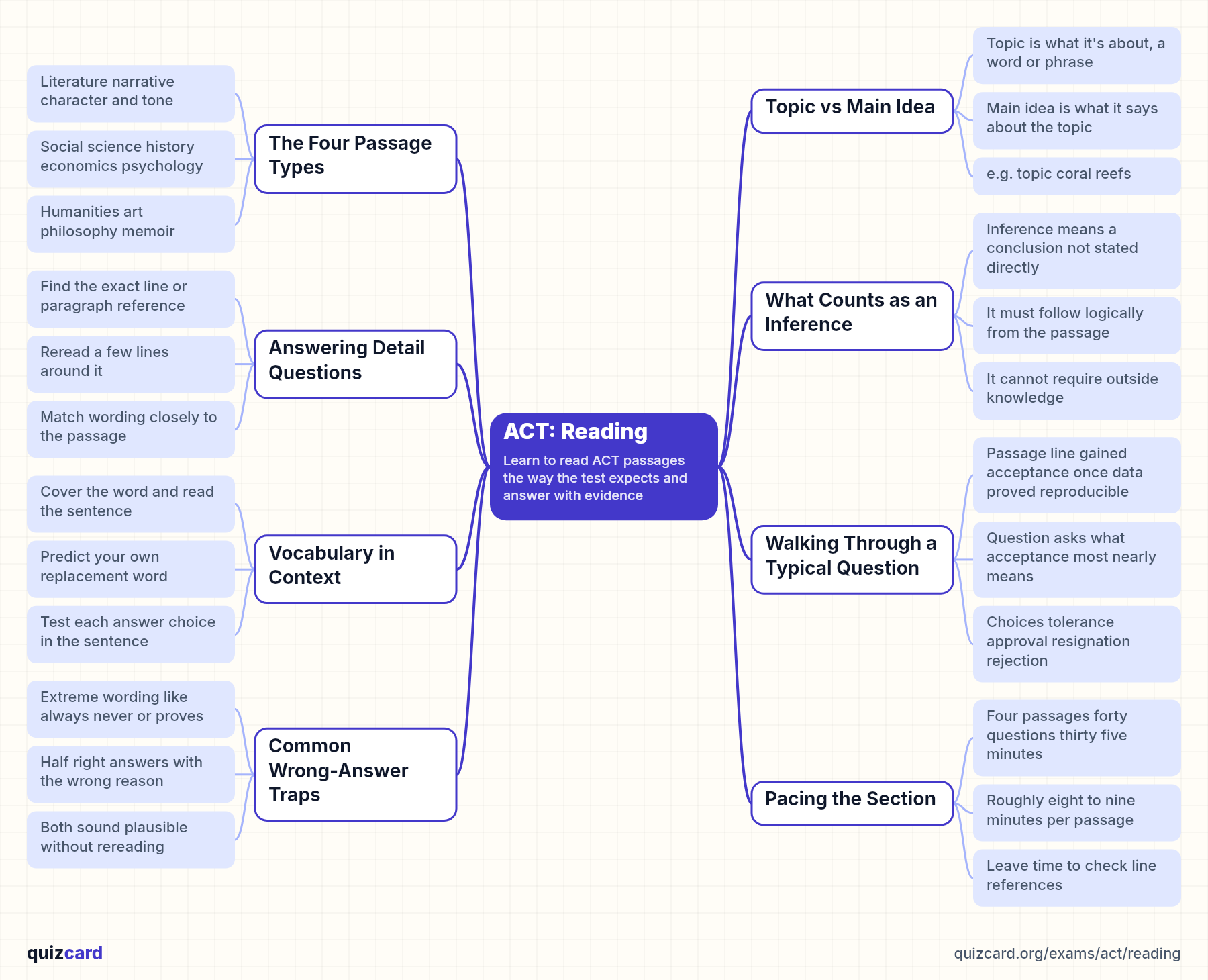
Ever pick the answer that sounds true but isn't actually written in the passage? That's the trap the ACT Reading test sets on purpose. In this video we'll break down the four passage types, the difference between a detail and an inference, how vocabulary-in-context questions work, and walk through a real question together.
The Four Passage Types
Every ACT Reading section has exactly four passages, always in the same order: literature, social science, humanities, and natural science. Literature passages focus on character and tone, often from a novel or short story. Social science covers things like economics or history. Humanities might be about music or philosophy. Natural science explains a process, like how a volcano forms or how antibiotics work. Knowing the type tells you what kind of questions to expect.
Key points.
- Literature narrative character and tone
- Social science history economics psychology
- Humanities art philosophy memoir
- Natural science biology chemistry physics
Topic vs Main Idea
Students often confuse the topic of a passage with its main idea, and the ACT loves testing that gap. The topic is just what the passage is about, something you could name in a word or two, like coral reefs. The main idea is the actual claim the author makes about that topic, for example that coral reefs are dying faster than scientists predicted. A main idea question wants that full claim, not just the subject matter.
Topic
- What the passage is about
- Usually one word or phrase
- Example: coral reefs
Main Idea
- What the passage claims about the topic
- A full sentence-level point
- Example: reefs are dying faster than expected
Answering Detail Questions
Detail questions, sometimes called referring questions, point you to a specific line or paragraph and ask what it states. The method is simple: go back to that spot, reread the sentences around it, not just the one line, and look for the answer choice that restates the passage closely. The ACT often writes wrong choices that sound plausible but add information the passage never actually gives, so stick tightly to what's printed.
- Find the line or paragraph reference
- Reread a few lines of context
- Match the answer to exact wording
- Reject answers that go further than stated
What Counts as an Inference
Inference questions ask you to go one step beyond what's written, but only one small step. The passage never says the answer in so many words, yet the evidence makes it the only reasonable conclusion. If a character slams a door and refuses to speak, you can infer they're angry even though the word angry never appears. The trap is inferring too much, bringing in outside assumptions the text doesn't actually support.
An inference is a conclusion that follows logically from the passage, even though the passage never states it directly. ACT Reading definition
Key points.
- Inference means a conclusion not stated directly
- It must follow logically from the passage
- It cannot require outside knowledge
- It should feel like the only reasonable conclusion
Vocabulary in Context
Vocabulary in context questions ask what a word most nearly means as it's used in that specific line, not its most common dictionary meaning. A good approach is to cover the word, read the sentence, and guess your own replacement first. Then test each answer choice in that same spot. The ACT often includes the word's common meaning as a wrong trap, hoping you'll pick it without rereading how it's actually used here.
- Cover the word, read the sentence
- Predict your own replacement word
- Test each choice in that sentence
- Pick the one matching the passage's tone
Walking Through a Typical Question
Say a passage reads: despite early skepticism, the scientist's method gained acceptance once her data proved reproducible. The question asks what acceptance most nearly means as used in that line, with choices tolerance, approval, resignation, and rejection. Rereading the sentence, the method moved from being doubted to being embraced because the data held up, so approval fits best. Tolerance is too weak, resignation and rejection both contradict the positive shift the sentence describes.
- Read the line: gained acceptance once data proved reproducible
- Note the question: what does acceptance mean here
- Test each choice against the sentence's shift in tone
- Pick approval, since it fits skepticism turning to embrace
Common Wrong-Answer Traps
Two traps show up again and again on this test. The first is the extreme answer, using words like always, never, or proves, when the passage is actually more careful and qualified than that. The second is the half-right answer, a statement that's technically true somewhere in the passage but doesn't actually answer the specific question being asked. Both traps sound reasonable at first glance, which is exactly why they catch students who skim instead of rereading.
Too Extreme
- Uses words like always, never, proves
- Goes beyond what the passage actually supports
Half Right
- A true statement but the wrong reason
- Matches the passage but not the question asked
Pacing the Section
The ACT Reading section gives you thirty five minutes for four passages and forty questions total, which works out to roughly eight to nine minutes per passage including the questions. That's tight, so the skill isn't just understanding the passage, it's managing time, moving past a question that's stumping you, and coming back to it rather than losing minutes on one line reference while three other passages are still waiting.
~9 min Target time per passage out of thirty five minutes for four passages and forty questions
Key points.
- Four passages forty questions thirty five minutes
- Roughly eight to nine minutes per passage
- Leave time to check line references
- Don't let one hard question eat your pace
Remember this
The one thing to remember for ACT Reading: every correct answer is anchored in the text, whether it's a stated detail or a one-step inference, never in outside assumptions. Now that you've seen the terms the ACT uses, try quizzing yourself on a real passage and see if you can catch the extreme or half-right traps.
Practice this unit
- Algebra and Geometry: Essential Formulas quiz18 multiple-choice questions with explanations · no account needed
- SAT Vocabulary: 40 High-Frequency Words quiz24 multiple-choice questions with explanations · no account needed
- GRE Quantitative: Arithmetic, Algebra, Geometry and Data Formulas quiz15 multiple-choice questions with explanations · no account needed
- Algebra and Geometry: Essential Formulas30 flashcards · study free
- Geometry: Proofs, Triangles, and Circles30 flashcards · study free
- English Literature: Literary Terms and Devices30 flashcards · study free
- SAT Vocabulary: 40 High-Frequency Words40 flashcards · study free
Every ACT deck and quiz: the ACT hub.
Other ACT unit guides
Try it with your own material
Upload a PDF, slides or notes and study the deck in minutes. Making your own cards is free with no limits.